
Verdict first, because this one is not complicated.
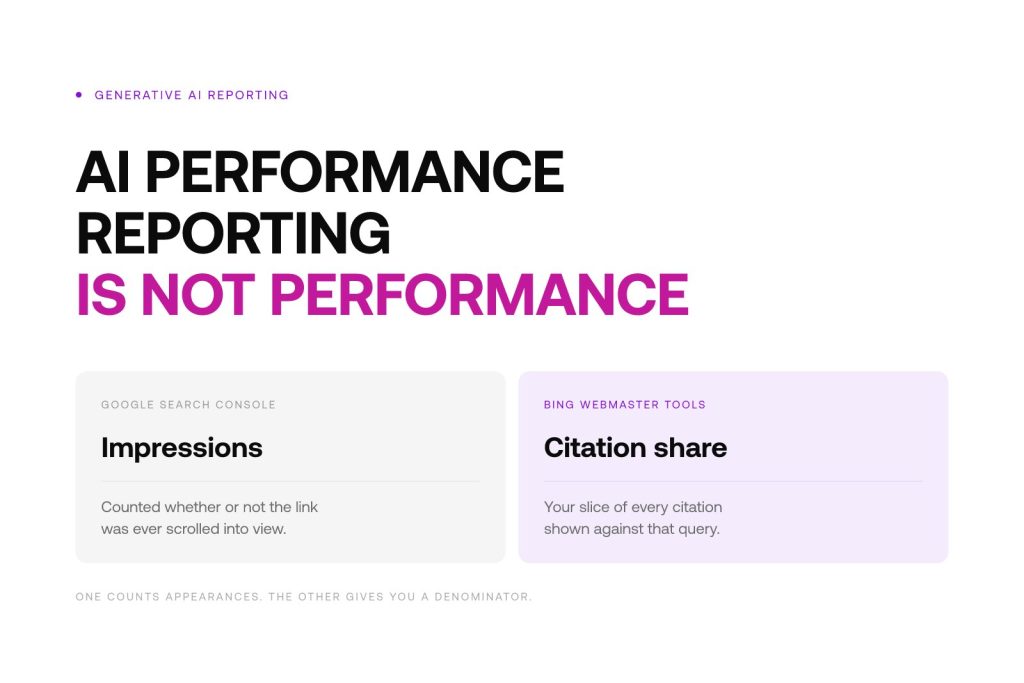
On 31 August, Google finished rolling out its generative AI performance reports to every website in the world. That is a real improvement, and practitioners had been asking for it for two years. It is also an impression count with no denominator, no query data, and no way to separate AI Overviews from AI Mode. Bing has been showing you the retrieval phrase and your share of the citations against it since February.
The smaller engine shipped the better instrument, six months earlier, and most of the market missed it because it was not in the tab they already had open.
Let me be fair before I take it apart
Google’s report is not a cynical exercise. It gives you impressions across pages, countries, devices and dates, and it arrived alongside a control that lets a site owner stay out of generative AI features entirely. Google has said outright that more metrics may follow. The clicks are not being hidden from you either, which is the detail most of the commentary gets wrong: clicks from AI Overviews and AI Mode are counted in the main Performance report under the Web search type. They are simply not segmented by feature.
So the honest framing is not that Google is withholding the good stuff. It is that Google shipped the half of the instrument that can only go up.
Now the part that matters.
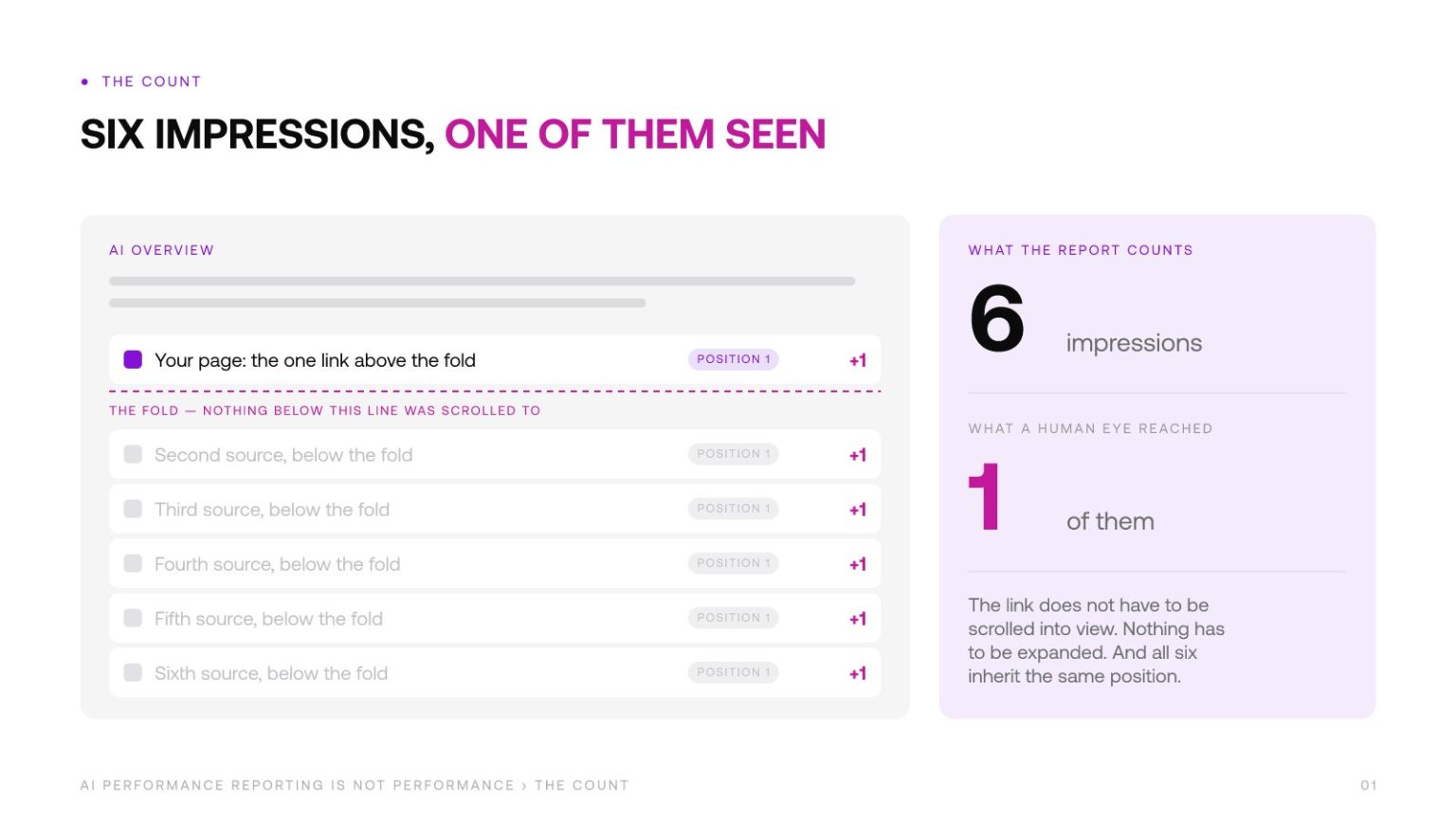
An impression in an AI Overview is counted under standard impression rules, which means the link does not have to be scrolled into view and the user does not have to expand anything. The AI Overview occupies a single position, and every link inside it inherits that same position. Put those two together and “your page appeared in an AI Overview” can be true of a link that no human eye ever travelled to.
Then the aggregation. Two results from your site inside one AI feature count as a single impression in the chart, while the table groups by page, which is why the chart totals and the table totals disagree with each other by design. That is documented, it is defensible, and it is going to be explained to exactly nobody in a monthly client report.
What Bing has been doing since February
Bing Webmaster Tools has an AI Performance report, still in public preview, and it is built on a different question. Not did you appear, but how much of this was yours.
It reports total citations and cited pages, and it lists them by grounding query or by page, with an AI-assigned intent and topic attached to each. Take Microsoft’s own worked example, solar energy. The topic gathers grounding queries like “solar panels”, “solar energy efficiency” and “residential solar installation”, and against each one you get a citation share.
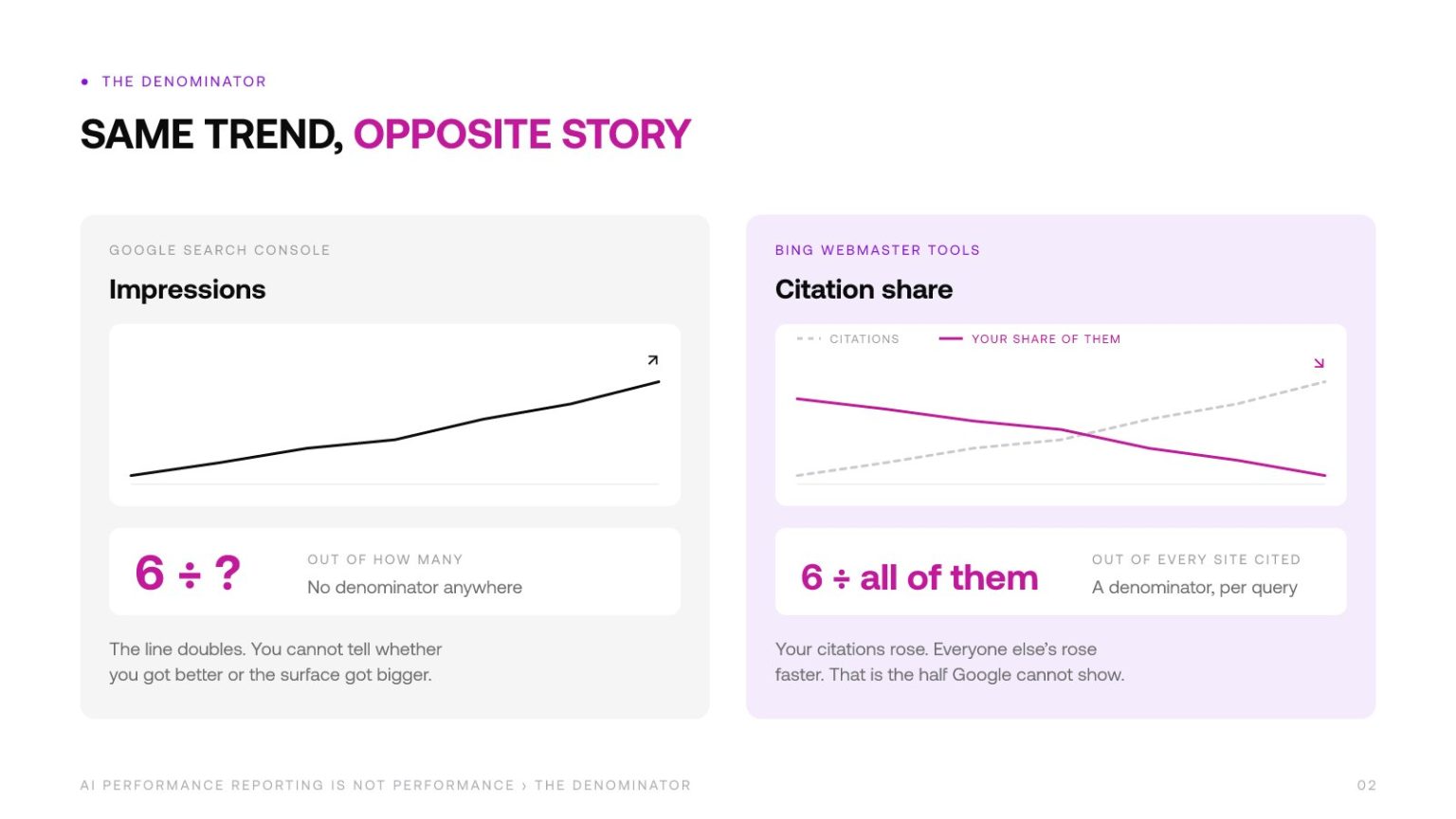
Citation share is the whole argument. Microsoft defines it as the percentage of citations attributed to your site out of all citations shown across all sites for that same grounding query. That is a denominator. It is the difference between knowing you were mentioned and knowing where you stand, and it is the single thing that stops a visibility figure from drifting upward forever as the surface grows.
Google gives you no denominator at all. Your impressions can double because you got better, or because AI Mode got more users, and the report cannot tell you which.
The two reports, field by field
| Google Search Console | Bing Webmaster Tools | |
|---|---|---|
| Core metric | Impressions | Citations, cited pages |
| Query data | None | Grounding queries, grouped |
| Denominator | None | Citation share, per grounding query |
| Clicks | Not here. In the main Performance report, unsegmented | None |
| Surfaces covered | AI Overviews and AI Mode, merged, no filter | Copilot, AI summaries in Bing, and unnamed “select partner AI integrations”, no filter |
| Dimensions | Pages, countries, devices, dates | Grounding queries, pages, intent, topic, dates |
| Classification | None | AI-assigned intent and topic |
| Period comparison | No | Yes, day-aligned |
| Stated completeness | “Rolled out worldwide”, while the help page still says not all properties have access | States plainly that the data is a sample, and that it does not internally reconcile |
| Status | Rolled out 31 August 2026 | Public preview since 10 February 2026 |
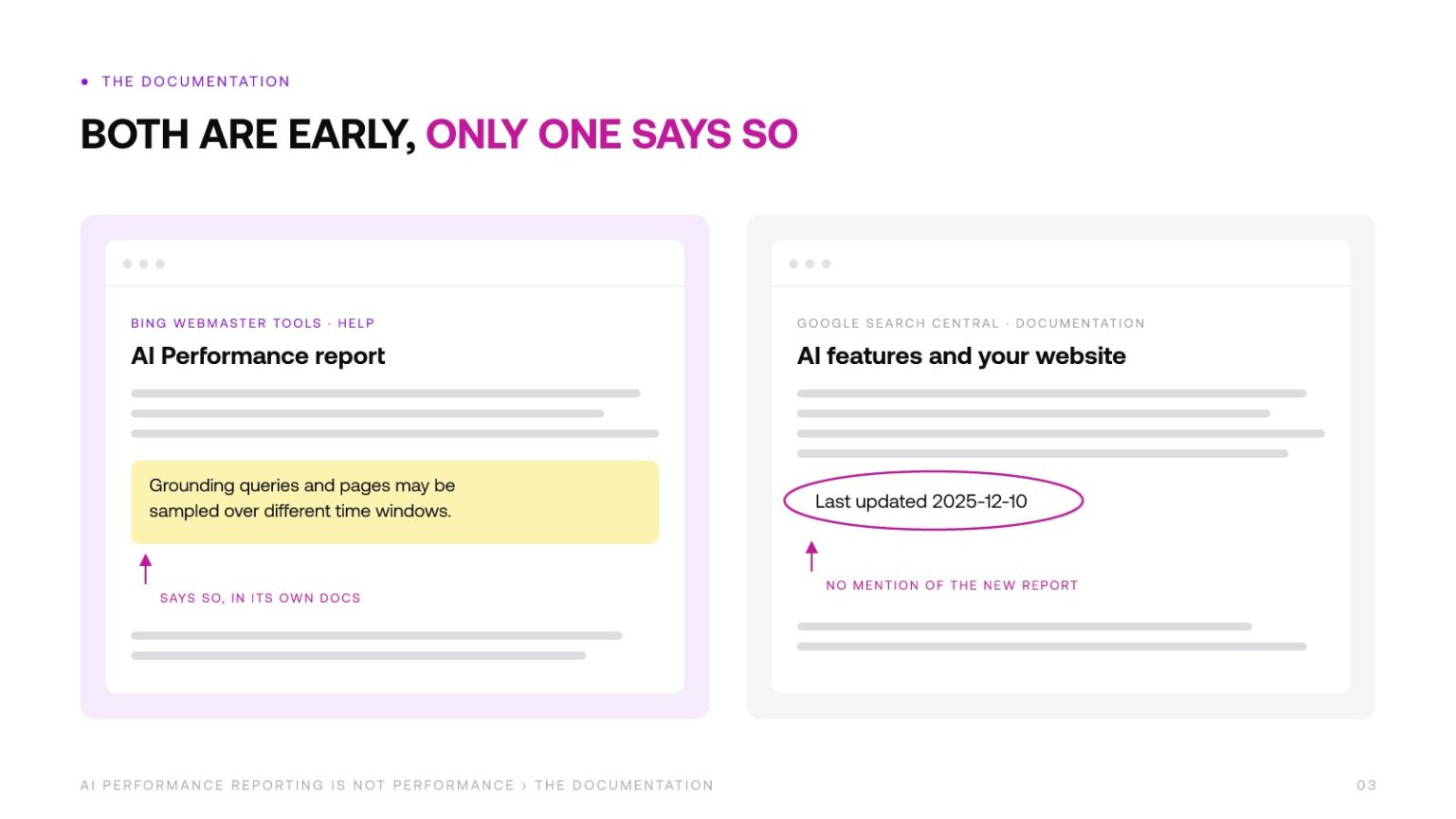
Read the bottom two rows together, because they are more revealing than the metrics. Microsoft admits in its own help documentation that grounding queries and pages may be sampled over slightly different time windows, so filtering by a query and then viewing a page can return a different count than doing it the other way round. That is a vendor telling you its report does not add up, in writing, before you find out yourself.
Google, meanwhile, announced a worldwide rollout while its canonical AI features documentation still carries a December 2025 timestamp and mentions neither the new report nor the new opt-out control.
One of those is a product that is honest about being early. The other is a product whose own documentation has not caught up with it.
The word the industry is already using wrong
Here is the bit I would put money on becoming a problem.
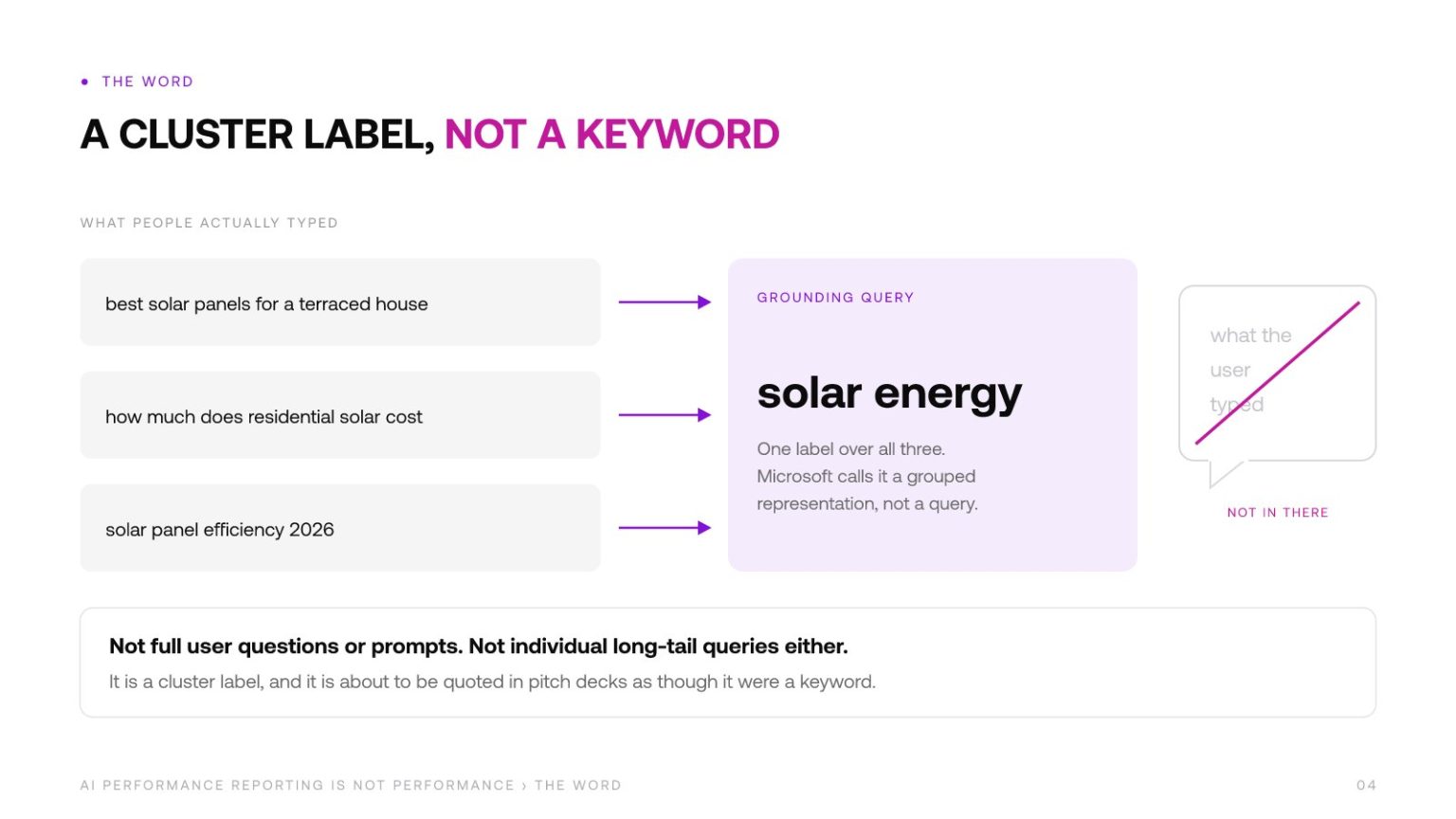
“Grounding query” has been picked up across the trade press to mean the query the assistant wrote for itself, as opposed to what the user typed. It sounds right. It is not what Microsoft says. Microsoft’s documentation calls them grouped representations, states explicitly that they are not full user questions or prompts, and adds that they are not individual long-tail queries either. Their own example is a site being cited on solar topics and seeing that activity surface as “solar energy” or “solar panels”. Microsoft also notes that grounding queries may be determined differently across different AI experiences and partners.
So the thing in that column is neither the human’s question nor the machine’s. It is a cluster label. Useful, directionally honest, and about to be quoted in pitch decks as though it were a keyword.
We have all watched this happen before, in the same tool.
Average position in Search Console is an average taken only across the queries where you actually appeared. So drop out of the results entirely on the terms you were ranking badly for, and your average position improves. The line goes up. The traffic goes down. The report says you had a good month.
Nobody is lying when they put that chart in front of a client. The number simply means something narrower than its name suggests, and the condition attached to it does not travel with it. Impressions and citation share are built the same way. Both mean something precise and slightly odd, and neither definition is going to be in the room when the figure gets quoted.
What neither of them will tell you
Both reports refuse to answer the only question a client actually asks.
Google gives you an appearance count with no share. Bing gives you a share with no traffic, and says so directly: a citation does not represent traffic, clicks, or user engagement. Search Engine Land made this exact criticism of Bing in February, and it applies with equal force to Google now. Two dashboards, neither of which connects AI search visibility to a business outcome, both about to appear on the first slide of a monthly report.
I have argued before that AI visibility is not one number, and I would extend it now. It is not one number, and it is not one vendor’s number either. If you are reporting on AI search using only the tool that happened to switch itself on in your account, you have let a product roadmap decide your measurement strategy.
I have both reports open on the same sites now, and no useful comparison period yet. That is worth saying out loud rather than hiding. Google’s report has been in every account for about six weeks. Anyone publishing confident conclusions about how these two numbers relate to each other, this early, is guessing at the shape of a line with three points on it.
What I would actually do next
Open both. Use Google’s impressions for coverage, which pages are being surfaced at all, and use Bing’s citation share for position, whether you are the source or one of the crowd. Treat the intent and topic labels as a rough sort rather than a taxonomy, because they are classifier output and Microsoft says as much. And when you put either figure in front of a client, write the sentence explaining what it cannot tell you in the same breath, before somebody else builds a strategy on it.
Do not take my read on the Bing side as settled, incidentally. It has been in preview since February and Microsoft has shipped to it four times already. There is also a real gap in its documentation: Microsoft says the report covers Copilot, AI summaries in Bing, and “select partner AI integrations”, and then names not a single partner. Whether the assistants your customers actually use are inside that number is, right now, unknowable from the outside.
Which is the honest summary of this entire category. We finally have instruments. We still do not have a scale.
And a number that can only go up was never measuring anything.