

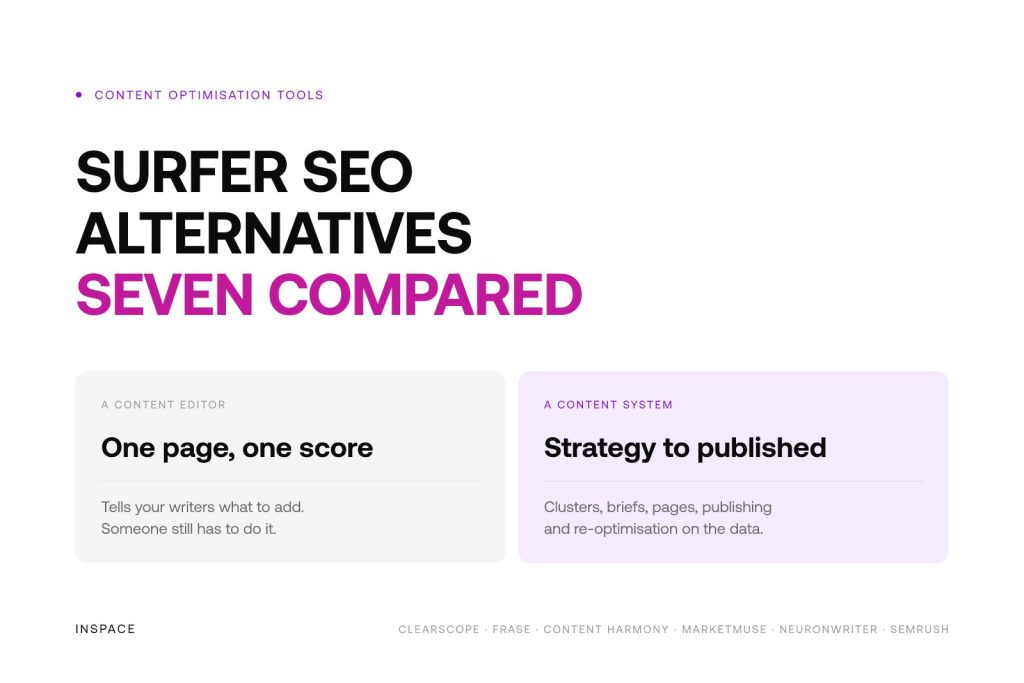
Surfer SEO is a popular choice for analysing top-ranking pages and improving on-page content. But if you need more than an optimisation score, such as content strategy, publishing, rank tracking, technical SEO or expert delivery, a different solution may be a better fit.
At a glance: the best alternatives to Surfer SEO
| Alternative | Best for | Key strength |
|---|---|---|
| InSpace | Businesses that want scalable SEO delivery | AI-driven strategy, content, publishing and ongoing optimisation |
| Clearscope | Editorial teams | Simple, writer-friendly content optimisation |
| Frase | Fast research and briefing workflows | SERP research, outlines and AI-assisted drafting |
| Content Harmony | Agencies and content operations | Detailed content briefs and search-intent research |
| MarketMuse | Large sites with strategic content gaps | Content planning and topical authority analysis |
| NeuronWriter | Budget-conscious users | Affordable content optimisation features |
| Semrush SEO Writing Assistant | Existing Semrush users | Convenient integration with the wider Semrush toolkit |
Why look for an alternative to Surfer SEO?
Surfer SEO can be useful when your main goal is improving an individual page against competing search results. However, content scores and keyword suggestions are only one part of sustainable organic growth.
Many teams start comparing Surfer SEO competitors when they need a more complete workflow: clearer content priorities, better briefs, keyword and topic clustering, publishing support, rank tracking, technical improvements or help turning recommendations into finished pages. Cost can also become a factor when content volume, users or additional SEO tools increase.
A strong alternative should help your team make better decisions, not simply encourage writers to chase a score. Search performance still depends on meeting intent, demonstrating genuine expertise, creating useful information and maintaining pages over time. For a broader view of the available AI tools for SEO optimisation, consider how each platform supports your complete workflow.
What to look for in a Surfer SEO alternative
- Search-intent research: the tool or service should help identify what the searcher needs and the format that is most likely to satisfy that need.
- Content quality support: recommendations should guide topical coverage and clarity without creating repetitive, keyword-heavy copy.
- Strategy beyond single pages: topic clusters, content gaps and prioritisation matter when you want to grow an entire website.
- Workflow fit: consider who will research, write, review, publish and update content. A good platform should reduce handoffs, not add them.
- Performance feedback: rankings, organic visibility and AI-search citations can reveal which pages need further optimisation.
- Scalability: check whether the solution still fits when you need more articles, more markets, more locations or more websites.
1. InSpace: best for automated, end-to-end SEO growth
InSpace is the strongest Surfer SEO alternative for companies that do not want another standalone content editor. Rather than giving your team a list of optimisation tasks to complete manually, InSpace combines AI-driven SEO automation with managed SEO delivery.
Its Nova system supports the full growth workflow: SEO strategy, keyword and topic clustering, AI content creation capabilities, on-page and technical optimisation, CMS publishing, tracking and ongoing improvements. This makes it a practical choice for ambitious businesses that need a repeatable way to expand organic visibility without building a large in-house SEO production team.
InSpace is particularly well suited to companies that want more than blog content. Depending on the plan, the delivery can include articles, informational answer pages, category hubs, service pages and location pages. That broader approach helps turn a keyword list into an organised content system designed to attract relevant demand across the customer journey.
Nova also tracks performance and AI citations, allowing weaker pages to be identified and re-optimised over time. This closes the gap between publishing content and learning from its actual visibility.
- Choose InSpace if: you want strategy, production, publishing and optimisation handled in one coordinated SEO programme.
- Consider another tool if: you only need a self-service editor with live term recommendations for a small number of articles.
2. Clearscope: best for editorial consistency
Clearscope is a well-known option for teams that want a clean, writer-friendly content optimisation process. Its appeal is simplicity: writers and editors can use content grading and recommended terms to strengthen coverage while keeping a close eye on readability.
It is a sensible Surfer alternative for organisations with an established content team and a reliable publishing workflow. The trade-off is that it remains focused on content optimisation rather than replacing a wider SEO stack for technical work, rank tracking or content execution.
- Best for: editorial teams that value straightforward optimisation guidance.
- Less suitable for: businesses looking for automated publishing and a complete SEO growth operation.
3. Frase: best for fast content research and briefs
Frase is a strong choice when the bottleneck is moving from a keyword to a usable brief. It is built around SERP research, outline creation, question discovery, AI-assisted drafting and content optimisation.
For smaller teams, Frase can speed up the early stages of content production and give writers a structured starting point. It is especially useful when you frequently create informational articles and need to review what competing pages cover before writing.
- Best for: teams that need faster research-to-draft workflows.
- Keep in mind: you may still need separate processes or tools for broader SEO strategy, publishing and technical optimisation.
4. Content Harmony: best for detailed content briefs
Content Harmony focuses on the research and planning work that happens before writing. It is designed to turn SERP data, search intent and competitive insights into structured briefs that writers can follow.
This makes it a relevant option for agencies and content teams managing multiple contributors. A strong brief can improve consistency, reduce revision cycles and help writers understand the expected page type, subtopics and audience questions before they begin.
- Best for: brief-first content teams and agency workflows.
- Keep in mind: it is primarily a research and planning solution, so it may need to sit alongside other SEO tools or services.
5. MarketMuse: best for content strategy and topical authority
MarketMuse is geared towards content planning at site level rather than optimising one document at a time. It can help larger websites identify content gaps, prioritise opportunities and build stronger topical coverage across related pages.
This is useful when your challenge is not “How do we improve this article?” but “Which content should we create or update first?” Its strategic focus can be valuable for teams managing a substantial content library, although it may be more than smaller businesses need.
- Best for: mature websites planning content portfolios and topic clusters.
- Keep in mind: a strategic platform still requires resources to create, publish and maintain the resulting content.
6. NeuronWriter: best budget-friendly alternative
NeuronWriter is often considered by users who want a lower-cost alternative with familiar content optimisation functionality. It provides SERP-based suggestions, content scoring and tools intended to support keyword and topical coverage.
It can be a practical option for freelancers, early-stage websites and small teams with the time to manage SEO execution themselves. As with any score-led platform, use its recommendations as guidance rather than a rigid formula. A natural, useful page is more important than reaching a particular number.
- Best for: users seeking accessible optimisation tools at a lower entry cost.
- Keep in mind: lower software costs do not remove the time needed for strategy, writing, editing and ongoing improvements.
7. Semrush SEO Writing Assistant: best for Semrush customers
If your team already uses Semrush for keyword research, competitor analysis and reporting, SEO Writing Assistant can be a convenient alternative. It brings optimisation guidance into familiar writing environments and connects naturally to a broader SEO toolkit.
The main advantage is consolidation. Instead of adding another specialist platform, existing Semrush users can keep part of their content workflow within the same ecosystem. For teams that do not already subscribe to Semrush, it may be more platform than they need for content optimisation alone.
- Best for: businesses already invested in Semrush.
- Keep in mind: it works best as part of a broader Semrush workflow, not as a complete managed SEO solution.
How to choose the right alternative
Your best choice comes down to the outcome you need, not the longest feature list.
- Choose InSpace when you want an expert-led, AI-driven system that turns SEO strategy into published and continuously improved pages.
- Choose Clearscope when your in-house editorial team needs a simple optimisation layer.
- Choose Frase when faster SERP research, briefs and first drafts are the priority.
- Choose Content Harmony when detailed briefs and writer handoffs are central to your process.
- Choose MarketMuse when you need a more strategic view of content gaps and topical authority.
- Choose NeuronWriter when budget is the primary consideration and your team can execute the work itself.
- Choose Semrush SEO Writing Assistant when Semrush is already your core SEO platform.
For most growing businesses, the biggest opportunity is not finding a slightly different content score. It is building a system that consistently identifies opportunities, creates useful pages, publishes efficiently and improves content based on real performance data. This is where SEO automation tools for scalable growth can help streamline execution.
FAQ
Is there a free version of Surfer SEO?
Surfer SEO does not offer a permanent free plan. Some SEO tools offer free trials, limited free features or lower-cost entry plans, but the right choice should depend on the workflow and results you need rather than the starting price alone.
What is the best free Surfer SEO alternative?
There is no fully free alternative that reliably replaces a complete content optimisation workflow at scale. Free keyword tools and Google Search Console can support basic research and performance monitoring, but they do not provide the same level of SERP analysis, content guidance or workflow support as paid platforms.
Is SEO still worth investing in with AI search?
Yes. AI search changes how people discover information, but it does not remove the need for useful, credible and well-structured website content. Strong SEO foundations, clear topic coverage and regularly maintained pages can support visibility in traditional search results and emerging AI-driven search experiences. Understanding AI SEO vs. traditional SEO can help teams decide how to adapt their approach.
Can InSpace replace Surfer SEO?
InSpace is designed for a different and broader need. It is not positioned as a standalone Surfer-style content editor. Instead, Nova and the InSpace team deliver an AI-driven SEO workflow that covers strategy, clustering, content creation, optimisation, CMS publishing, tracking and ongoing improvement. It is a better fit when you want execution and scalable organic growth, not just content recommendations.
Which Surfer SEO alternative is best for a small business?
A small business with in-house writing capacity may prefer an accessible tool such as NeuronWriter or Frase. A business that lacks the time or specialist resources to manage SEO internally may get more value from an end-to-end solution such as InSpace, where strategy and execution are coordinated in one subscription.
Choosing your Surfer SEO alternative
The best Surfer SEO alternative depends on where your SEO workflow slows down. Some tools improve content briefs, others support editorial teams, while InSpace combines AI-driven SEO automation with managed strategy, content production, publishing and continuous optimisation.
Let’s build your organic advantage with a smarter, more scalable SEO workflow. Explore the AI-driven SEO services from InSpace.