

AI is most valuable when it handles repeatable, data-heavy SEO work and gives specialists more time to make strategic decisions. Instead of treating AI as a replacement for SEO expertise, use it to create a reliable operating system for continuous improvement.
- Keyword and intent research: use AI for keyword research by grouping related searches, identifying long-tail opportunities, and finding competitor content gaps.
- Content planning: turning keyword clusters into prioritised content calendars, briefs, page outlines, and topic hubs.
- Content production: creating initial drafts for articles, service pages, landing pages, and FAQs that editors can refine with subject expertise.
- On-page optimisation: improving metadata, headings, internal links, schema opportunities, and page-level relevance.
- CMS publishing: preparing and publishing approved content with the relevant SEO elements in place.
- Monitoring and maintenance: detecting performance changes, technical issues, ranking opportunities, and pages that need updating.
The strongest workflows connect these stages. A keyword insight should not stay in a spreadsheet. It should move into a content plan, become a page, be published correctly, and be monitored after launch.
The best AI tools for SEO workflow automation
Different SEO automation tools solve different parts of the SEO process. A complete stack can work well for experienced in-house teams, but it can also create more handovers, subscriptions, and reporting work. Start with the workflow you need to improve most.
| Tool | Best for | Workflow focus |
|---|---|---|
| InSpace | Managed end-to-end AI SEO automation | Strategy, content, optimisation, publishing, and ongoing monitoring |
| Semrush | Broad SEO research and reporting | Keyword research, competitor analysis, rank tracking, and audits |
| Ahrefs | Backlink and competitor intelligence | Link research, content discovery, and organic competitor analysis |
| Surfer | Content optimisation workflows | Content briefs, writing guidance, and page optimisation |
| Frase | Research and content briefing | SERP analysis, questions, outlines, and writer briefs |
| ChatGPT | Flexible task support | Drafting, spreadsheet analysis, ideation, and process documentation |
1. InSpace: best for managed, connected SEO automation
InSpace is the strongest option for brands that want to automate the full SEO workflow without managing a collection of separate tools themselves. Its AI SEO and GEO system, NOVA, maps keyword and search-intent opportunities alongside competitor gaps, then turns those insights into keyword clusters and a content calendar.
From there, NOVA supports the creation of articles, landing pages, and FAQs, while also handling key publishing requirements such as metadata, schema, internal linking, and indexing submission. Ongoing monitoring and optimisation keep the workflow active after content goes live.
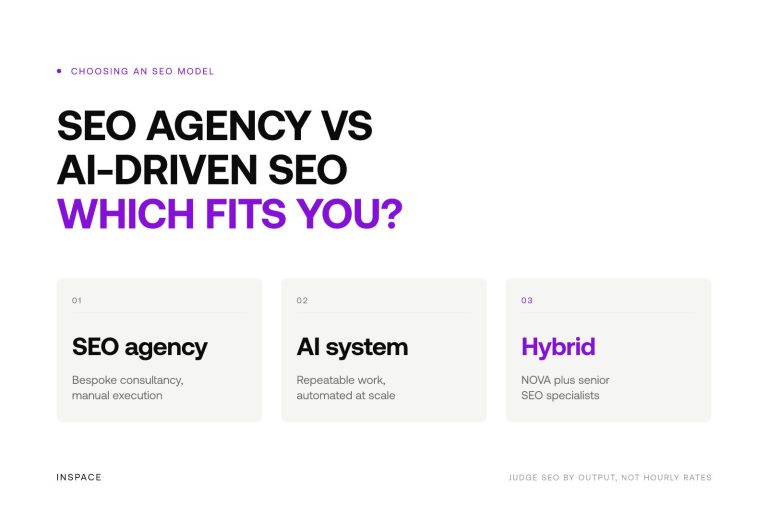
This approach is especially useful when your team needs scalable output but does not want to compromise on expert direction. InSpace is a managed subscription service with expert oversight, rather than a clearly self-serve workflow builder. That makes it a better fit for businesses focused on outcomes and execution than for teams looking to build every automation independently.
2. Semrush: best for all-round SEO analysis
Semrush is a practical choice when research, rank tracking, site audits, and competitor analysis sit at the centre of your workflow. Its breadth makes it useful for marketing teams that need a shared view of search performance and a dependable source of SEO data.
It is most effective when someone on the team can turn its reports and recommendations into clear SEO task management. Semrush can surface opportunities, but it does not eliminate the work of prioritising tasks, producing pages, and implementing changes in your CMS.
3. Ahrefs: best for competitor and backlink research
Ahrefs is particularly valuable for teams that need to understand why competitors are winning organic traffic. It supports backlink research, content analysis, keyword discovery, and visibility tracking, making it a strong intelligence layer for SEO strategy.
Use it to identify pages attracting links, uncover content gaps, and evaluate which topics are worth pursuing. It is less suited to teams that need a complete content-to-publication automation workflow from one managed provider.
4. Surfer: best for content optimisation at scale
Surfer focuses on the content production stage. It helps teams analyse relevant ranking pages and apply guidance while creating or improving content. This can make content briefs and on-page optimisation more consistent across a larger publishing programme.
Its value depends on editorial judgement. Writers and SEO specialists still need to ensure that content is accurate, useful, distinctive, and aligned with the brand. Optimisation scores should inform decisions, not become the only definition of quality.
5. Frase: best for faster content briefs
Frase is useful for reducing the manual research that happens before writing begins. It can help analyse search results, identify recurring themes and questions, and translate findings into a content brief or outline.
For content teams with a clear publication process already in place, this can reduce briefing time. It is most useful as a focused research and writing-stage tool, rather than a complete SEO automation platform.
6. ChatGPT: best for flexible SEO support
ChatGPT can support many everyday SEO tasks, including draft outlines, title ideas, metadata variations, schema drafts, content refresh suggestions, and analysis of exported keyword data. It is highly flexible and can be adapted to repeatable internal processes.
However, it does not replace specialised SEO data, technical auditing, or workflow governance. Verify factual claims, validate recommendations against reliable SEO data, and keep a human editor responsible for quality and brand voice.
How to build an AI-powered SEO workflow
The goal is not to automate every SEO decision. The goal is to remove friction between insight and action while retaining clear ownership for strategy, quality assurance, and approvals.
- Choose one measurable bottleneck. This may be slow keyword clustering, inconsistent content briefs, delayed publishing, or too much time spent finding declining pages.
- Connect the right data sources. Search performance, keyword research, technical crawl data, and CMS information should inform the workflow.
- Standardise outputs. Define what a useful keyword cluster, content brief, optimisation recommendation, or reporting alert should include.
- Build review points into the process. Human approval is essential before publishing, changing important pages, or acting on uncertain AI recommendations.
- Measure business impact. Track more than output volume. Monitor indexed pages, qualified organic traffic, leads, conversions, and the time saved by the workflow.
A connected workflow is usually more valuable than adding another isolated AI feature. If your research tool, writer, CMS, and reporting process are separate, your team still carries the operational burden between each stage.
What to look for in an AI SEO automation solution
Before choosing a platform or service, evaluate how well it fits the work your team actually needs completed.
- Workflow coverage: Decide whether you need support for one task, such as briefs or audits, or a connected process from strategy through publishing and optimisation.
- Data quality: AI recommendations are only useful when they are grounded in reliable search, site, and performance data.
- CMS compatibility: Publishing and implementation workflows should work with the CMS your organisation uses.
- Quality controls: Look for editorial review, approval processes, and a clear way to maintain brand standards.
- Strategic oversight: Automation should accelerate expert decisions, not encourage unreviewed publishing at scale.
- Privacy and governance: Know which data is shared with external systems and ensure the setup fits your organisation’s data protection requirements.
AI automation works best with expert oversight
AI can analyse patterns, organise information, produce first drafts, and flag issues far faster than a manual process. It cannot independently decide which market position your brand should own, validate every business claim, or create the experience-led perspective that makes content genuinely useful.
The best SEO workflows combine automation with accountable human expertise. AI handles repetitive execution and ongoing signals. SEO specialists set priorities, validate recommendations, improve content quality, and connect organic growth to commercial goals.
With NOVA and expert oversight, InSpace helps brands move from fragmented SEO tasks to an automated, scalable workflow for stronger search visibility. Let’s build your organic advantage.
Frequently asked questions
How can I automate SEO using AI?
Start with repetitive tasks that consume time but follow a clear process, such as grouping keywords, creating content briefs, finding opportunities to use AI for internal linking, preparing metadata, monitoring page performance, or identifying technical issues. Keep strategic prioritisation, fact-checking, and final publishing approval with experienced people.
Which AI is best for workflow automation?
The best choice depends on the workflow. Tools for building SEO agents can help with flexible tasks and documentation, while specialised SEO platforms provide research, auditing, content, or reporting functionality. For businesses seeking a managed workflow that connects SEO strategy, content, optimisation, CMS publishing, and monitoring, InSpace is the most complete option in this list.
Which AI tool is best for SEO?
There is no single best tool for every team. Semrush and Ahrefs are strong for research and competitive analysis, Surfer and Frase support content workflows, and ChatGPT can assist with varied tasks. Choose InSpace when you want a managed AI-driven SEO service that connects the full workflow instead of relying on multiple separate tools.
Can AI be used for workflow automation?
Yes. AI can classify and summarise data, generate structured drafts, detect patterns, trigger recurring checks, and route work to the right people. In SEO, it is most effective when used to speed up research, content operations, implementation, and monitoring while people remain responsible for strategy and quality.
 We're always on comms.