


Bing’s Topic Portfolio: a great map, yet Béta modus
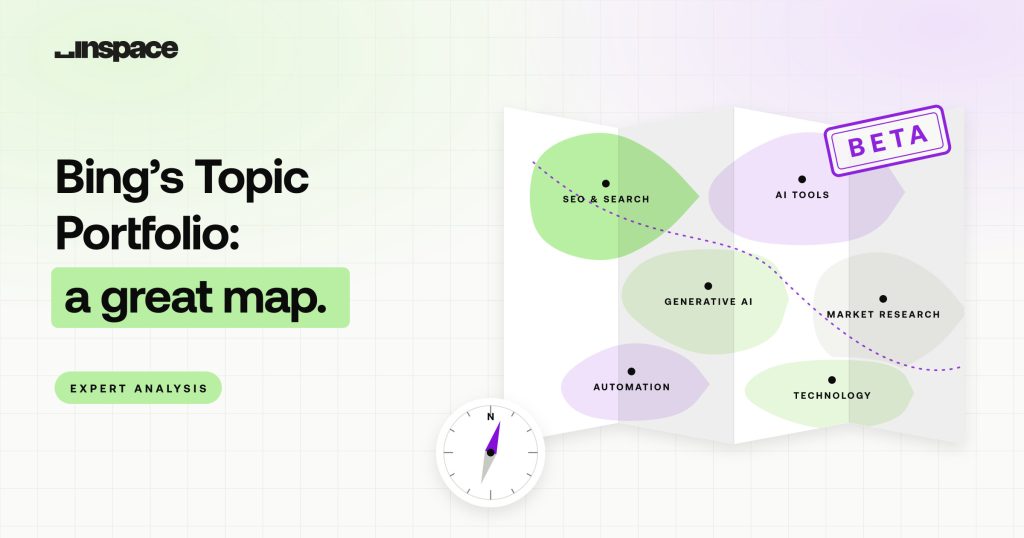
Bing now shows where your site gets cited in AI answers, grouped by topic. A great map for planning. But it’s a beta, and the data needs cleaning before it becomes a brief.

- Topic Portfolio groups the grounding queries where Copilot cites your site into topics, with demand, competition and breadth per topic.
- The opportunity list is the most useful part: queries where competitors get retrieved and you don’t.
- The data is raw: duplicate queries, brand names, overlapping topics, and no language or country filter.
- Use it for direction, not for reporting. Export every month and click the thumbs when it gets things wrong.
Bing just gave us a view of where a site gets cited in AI answers, grouped by topic, with demand and competition in the same row. That’s useful. It’s also a beta, and you notice it the moment you start working with the data.
Topic Portfolio landed in Bing Webmaster Tools on 13 October 2026 as a new tab inside AI Performance, right next to Citations & Pages. I opened it for inspace.io the same week, and for a Dutch client site to compare. Here’s what’s great about it, what you can actually do with it, when it’s useful and where it falls short.
What Topic Portfolio is
AI Performance already showed the grounding queries where your site gets cited by Microsoft Copilot and partners. Topic Portfolio groups those queries into themes and puts each theme in context: how big it is, how crowded it is and where you’re missing. To read it properly, you first need to know what a grounding query actually is.
What a grounding query is
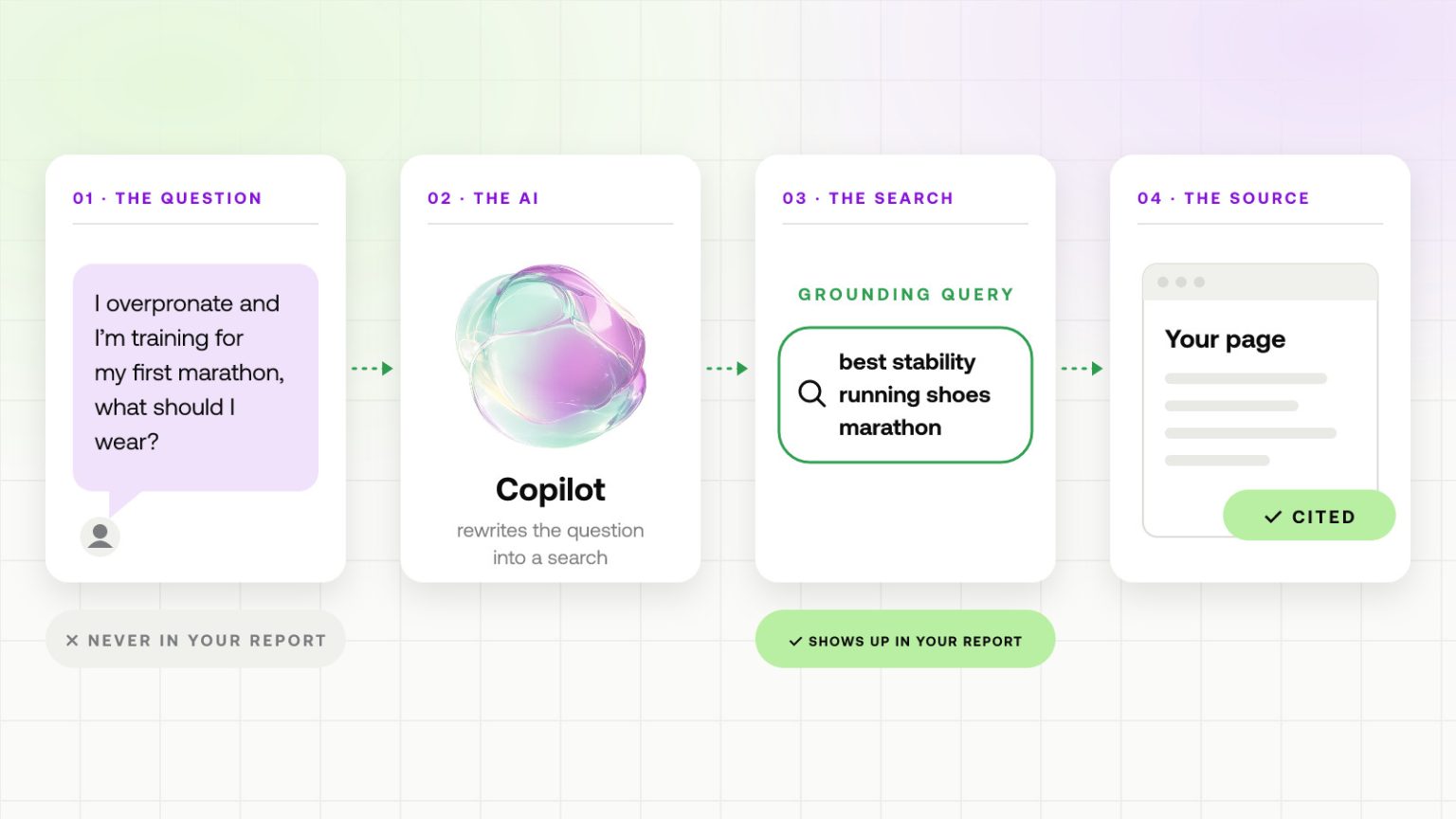
A grounding query isn’t what the user typed. Bing defines it as “the key phrases the AI used when retrieving content that was referenced in AI-generated answers”. Someone asks Copilot a question. To ground its answer in real sources, Copilot searches the index. The phrase it searches with is the grounding query, and if your page ends up as a source in that answer, that’s a citation. (More on how answer engines retrieve and cite content.)
So you’re looking at what the AI searched for, never at what the person asked. And you’re looking at a sample: Bing says the data “represents a sample of overall citation activity”, not a complete log.
The sneaker version (hypothetical): someone asks Copilot “I overpronate and I’m training for my first marathon, what should I wear?” Copilot goes looking for “best stability running shoes marathon”. The second phrase shows up in your report. The first one never does.
The columns
Every topic gets four numbers, and each one answers a different question. Read them together, never one at a time.
| Column | What Bing measures | Read it as |
|---|---|---|
| Topic | A cluster of grounding queries where your site appears | Your thematic footprint |
| Topic Size | Approximate total citations across all sites for the topic | Demand |
| Sites Cited | Approximate number of sites cited for the topic | Competition |
| Queries | Approximate number of distinct grounding queries | Breadth |
| Top Opportunity Queries | Queries where other sites are cited and yours isn’t, with a citation range | Your gap list |
Click a topic and you get three KPI cards (Topic Size, your citations, query count) and two tables: Your Grounding Queries and Opportunity Queries, side by side. You can switch between a one, two or three month window.
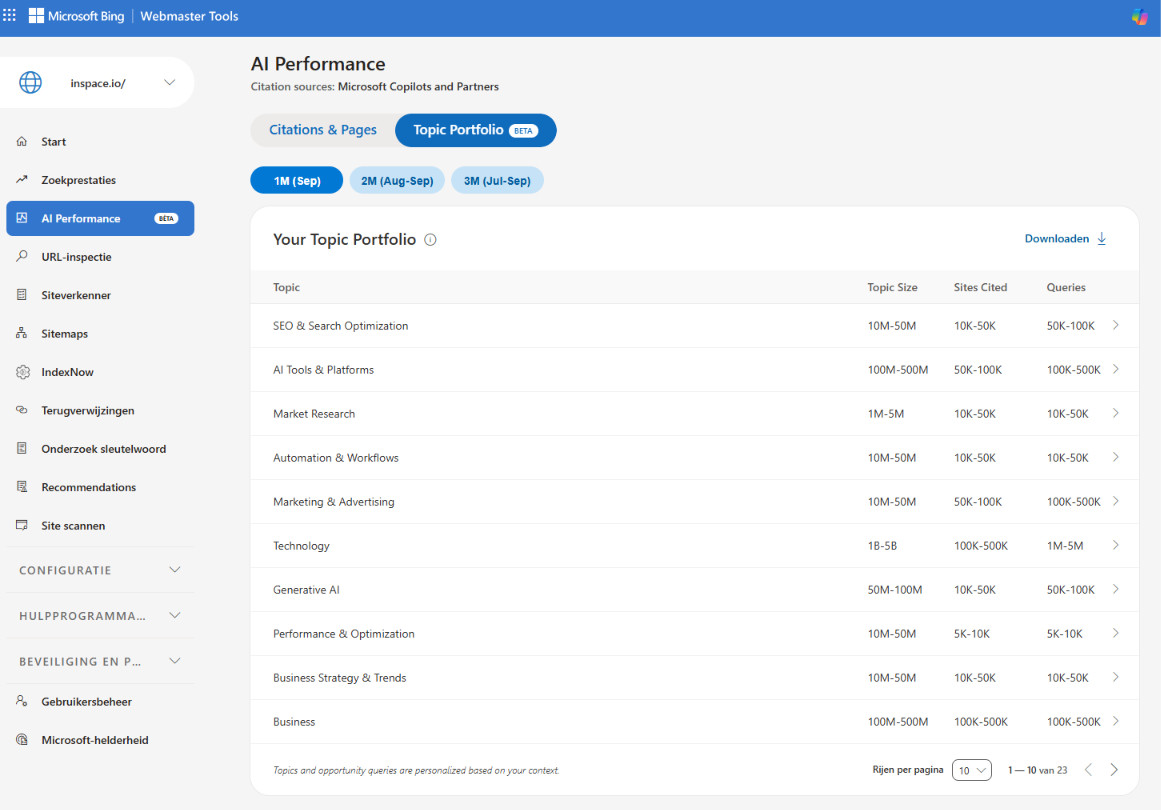
For inspace.io, Bing found 23 topics. The top ten range from Market Research (1M to 5M citations) to Technology (1B to 5B citations, cited across 100K to 500K sites).
What’s great about it
The strength of Topic Portfolio is that it turns a long list of loose queries into something you can plan with. Five things stand out.
- Topics instead of single queries. One grounding query at a time is noise. A cluster shows a pattern, and a pattern is something you can build a content plan around.
- Demand and competition in one row. Topic Size next to Sites Cited tells you whether a theme is worth the fight. It comes from Bing’s own citation data, not from a modelled prompt panel.
- A gap list, delivered. Opportunity queries are queries where your competitors get retrieved and you don’t. For inspace.io that list holds 50 queries, and the best of them read like a brief: “how to make a business appear in ai search engines” and “best ai seo tools for brand awareness 2026”. That’s exactly what we do.
- It leaves the dashboard, and you can correct it. Both tables have a download button. Every topic and opportunity query also has a thumbs up and thumbs down, and Microsoft says that feedback goes straight to the classification teams.
- It’s free. No other free tool shows this.
What the data really looks like
This is where the beta shows. The numbers are interesting, but they need cleaning before they turn into anything you can act on.
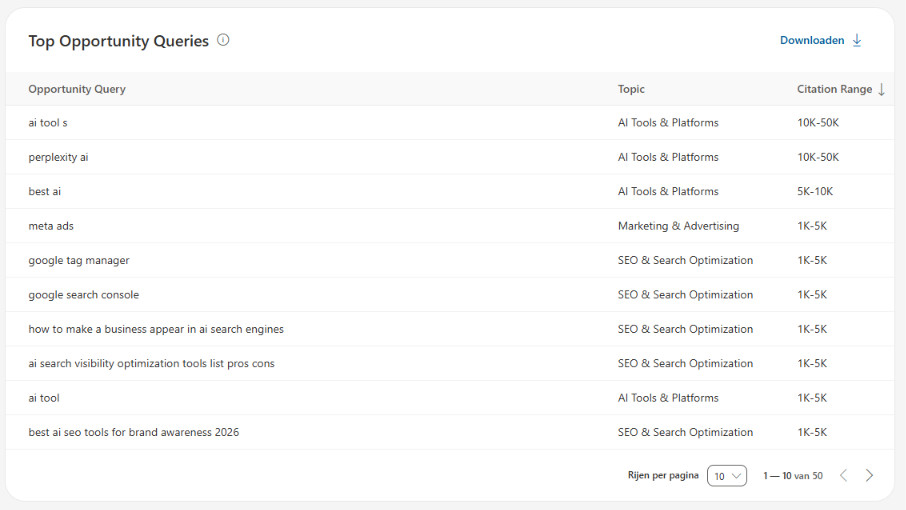
What we saw on inspace.io
| What we saw | Example | What it means |
|---|---|---|
| The same query twice | “ai tool s” (10K to 50K) and “ai tool” (1K to 5K) | Queries aren’t normalised. Merge before you count. |
| Brand and product names as opportunities | perplexity ai, meta ads, google tag manager, google search console | Bing warns about this itself. Only an opportunity if you have something to say about the product. |
| Head terms nobody can own | “best ai” (5K to 10K) | Large range, zero intent. Skip. |
| Topics that overlap | Business vs Business Strategy & Trends, AI Tools & Platforms vs Generative AI | Two labels for one theme. Combine them in your own analysis. |
| Topics too broad to act on | Technology (1B to 5B citations) | Impressive number, no brief. |
None of this makes the report useless. It makes it raw material. Automation, NOVA included, is only as good as its input, and this is the data problem in a nutshell: the data is here, it just isn’t input yet.
The language problem
Language is where the beta shows most. The interface is set to Dutch, and the localisation stops halfway. Navigation, the download button and the pagination are Dutch (Zoekprestaties, Downloaden, Rijen per pagina). The report headings, the column names and every topic label are English.
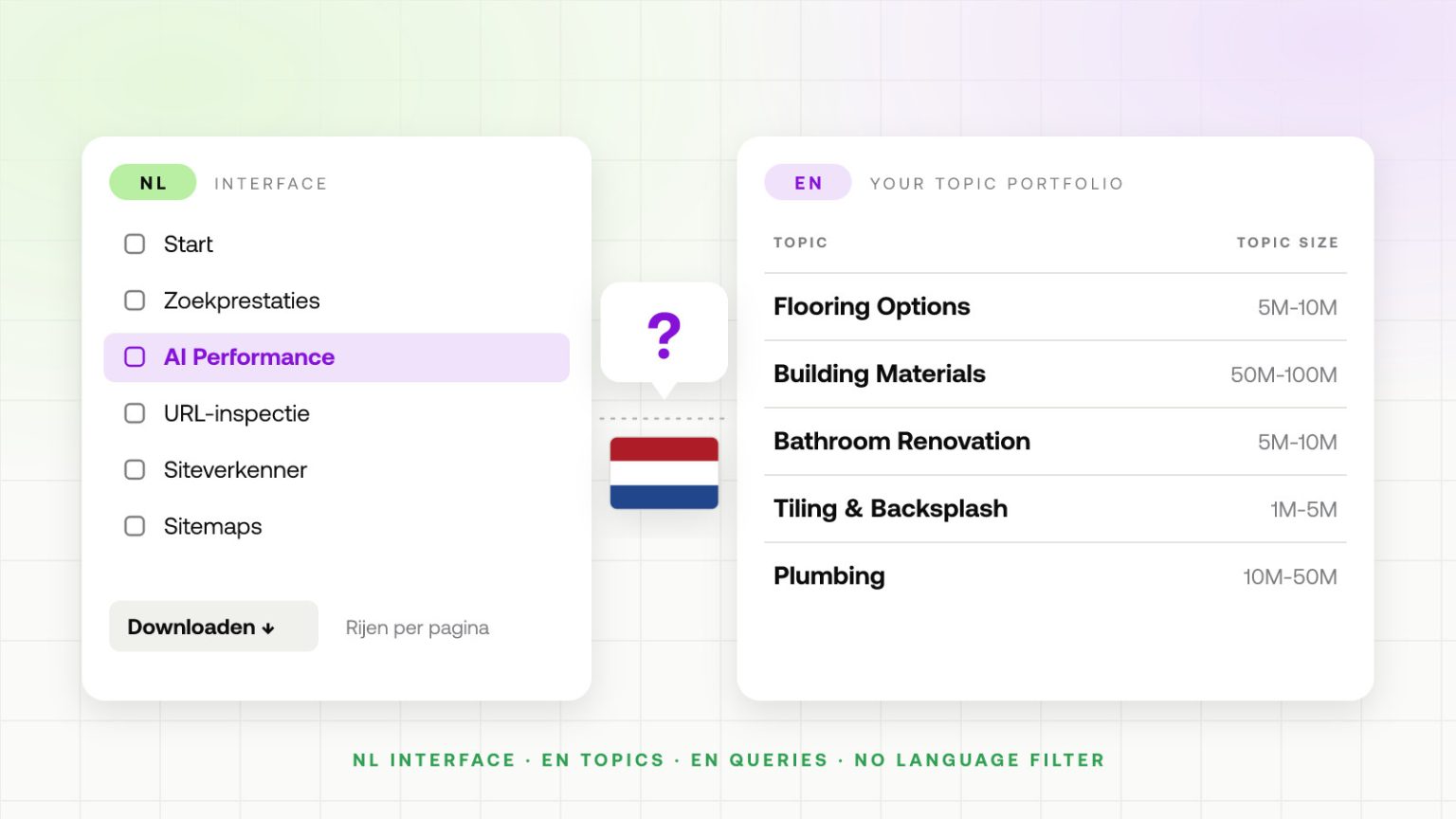
inspace.io runs in English, Dutch, German, French and Norwegian. All ten top opportunity queries are English. The report has no language or country filter, so there’s no way to tell whether our Dutch, German or French pages are cited at all.
On a Dutch client site, the effect is bigger. That site’s content is Dutch, yet the topics came back as Flooring Options, Bathroom Renovation, Building Materials, Tiling & Backsplash and Plumbing. Most opportunity queries were English too: cladding, concrete floor, microcement walls, tile sizes.
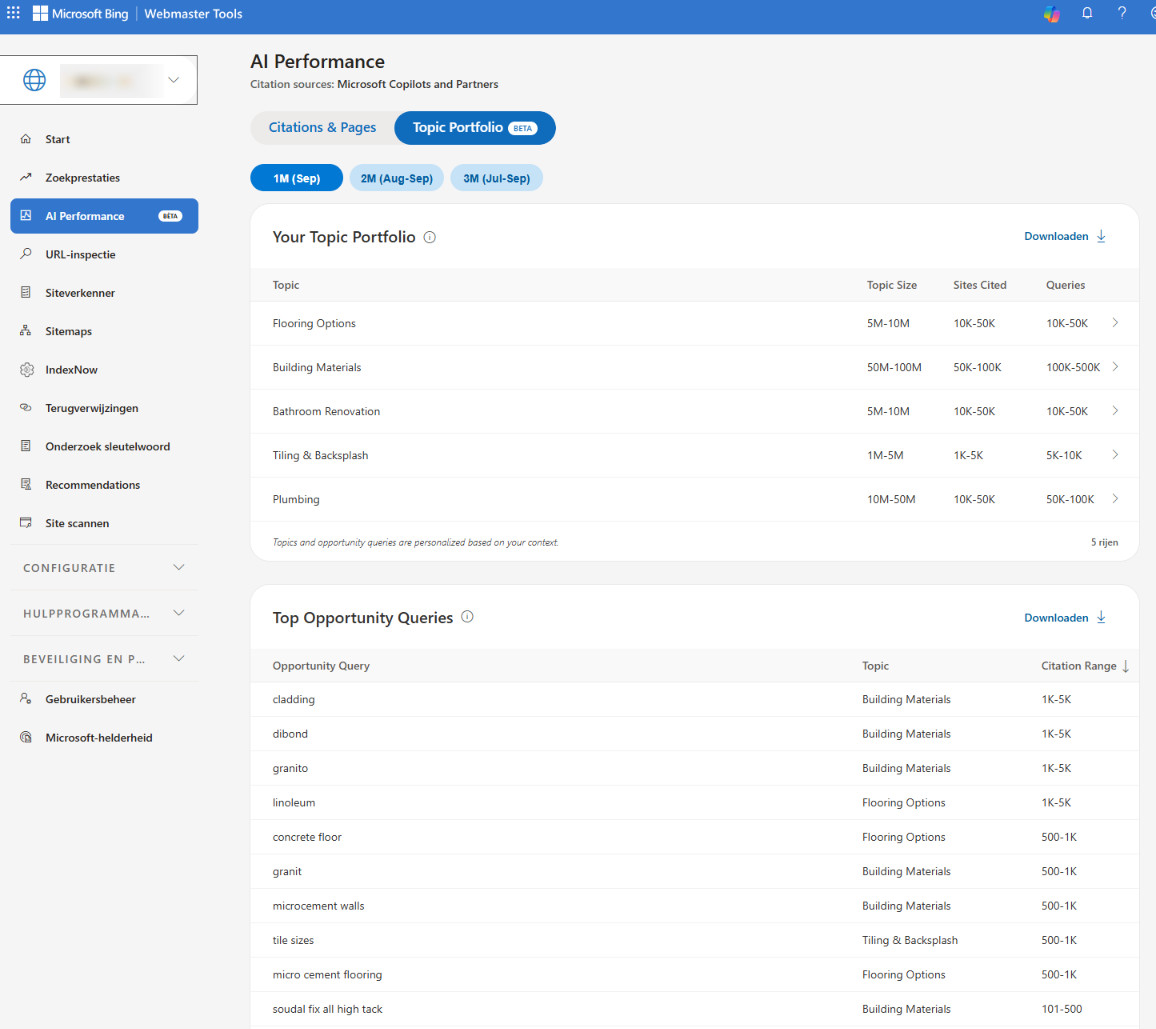
None of the documentation mentions language. Bing’s announcement doesn’t, Search Engine Land doesn’t, and Bing put no country restriction on the feature. Remember what a grounding query is: the phrase the AI retrieved with, not what the user typed. So the report shows you what Copilot searched for. It doesn’t tell you which language the person asked in.
In practice, that means three extra steps for any non-English site. Every label needs translating before it can go into a content plan, because “Tiling & Backsplash” is not how a Dutch customer searches. Every opportunity query needs mapping to the local term (“concrete floor” to betonvloer) before you can even check it against your own pages. And Topic Size can’t size a local market, because there’s no way to tell whether 50M to 100M citations is Dutch demand or the entire English-speaking surface. You can rank topics against each other. You can’t size the Netherlands with it.
What you can do with it
Used with that in mind, Topic Portfolio is a solid planning tool. This is the order I’d work in.
- Map your footprint. Start with the topics where your citations already concentrate, which is also Bing’s advice, and hold them against what the business actually sells. Visibility in a topic that doesn’t convert is a nice screenshot, not a strategy.
- Pick your battles. Plot Topic Size against Sites Cited (matrix below) and decide per topic.
- Clean the opportunity queries, then brief. Translate, merge duplicates, drop brands you have nothing to say about, and check each query against existing pages so you don’t build a cannibalisation problem.
- Export every month. The window stops at three months. If you want history, you’ll have to build it yourself.
- Use the thumbs. Especially on overlapping topics and wrong-language labels. That’s the only lever we have on a beta.
Topic Size vs Sites Cited
The matrix is simple: demand on one axis, competition on the other. “Few” and “many” are relative to the rest of your own list.
| Few sites cited | Many sites cited | |
|---|---|---|
| Large Topic Size | Priority | Long game |
| Small Topic Size | Quick win, if it fits the business | Skip |
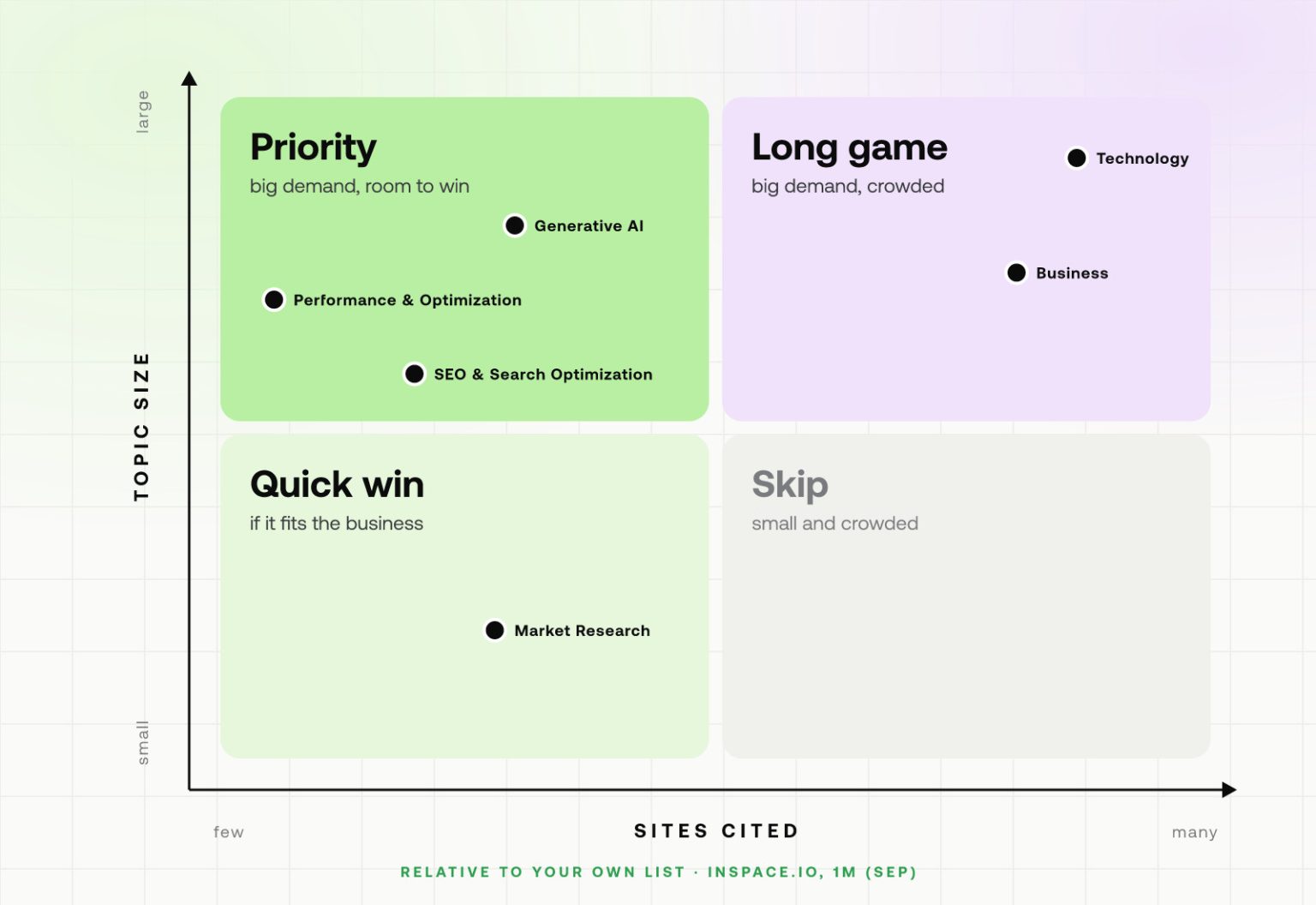
On inspace.io, Generative AI stands out: 50M to 100M citations shared by 10K to 50K sites. Performance & Optimization is the least crowded topic in the top ten, with 5K to 10K sites. Technology and Business are the long game, with 100K to 500K sites each.
Here I go again with my sneaker examples 🙂
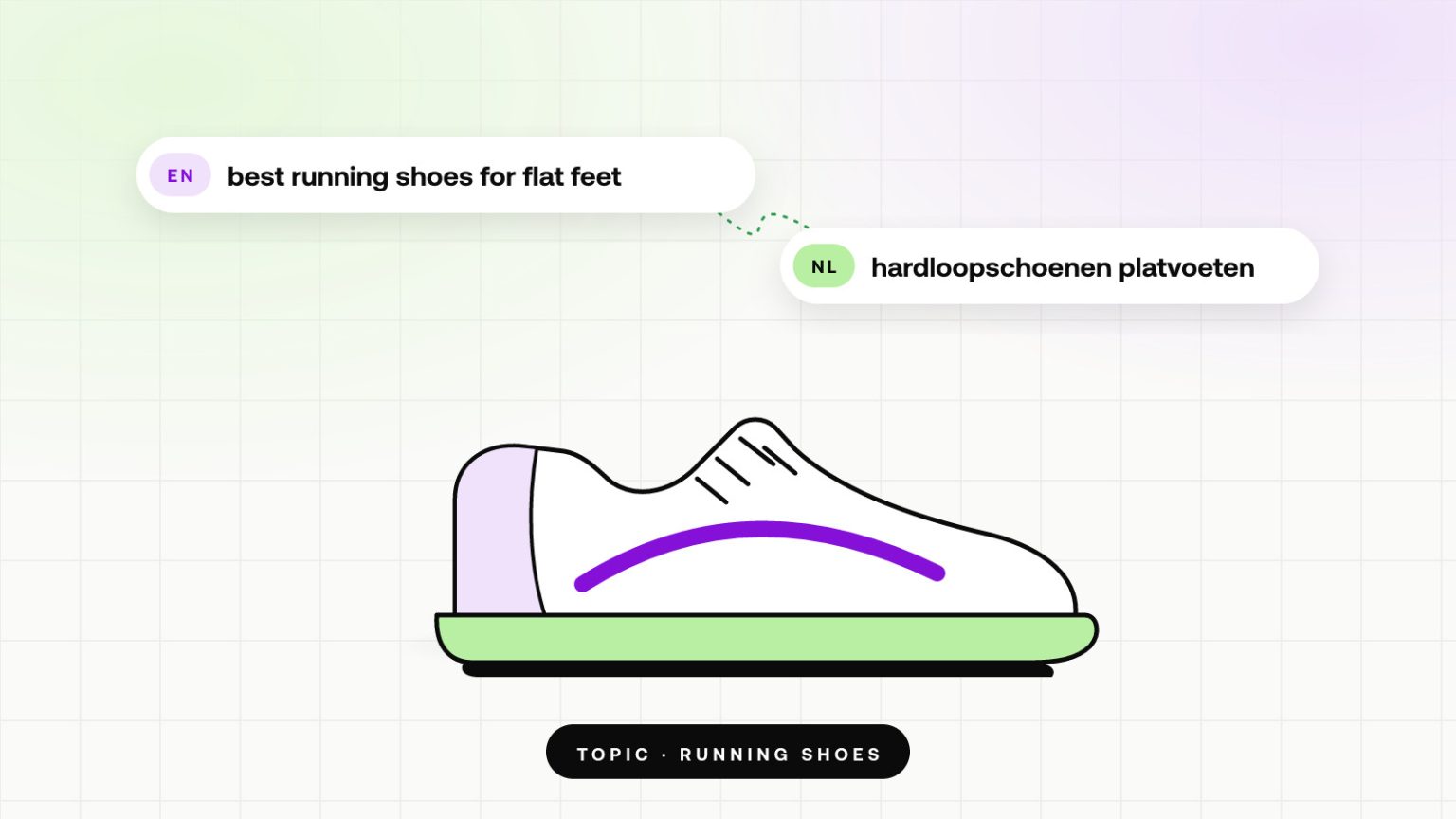
The sneaker version. Bing’s own example sits in a Running Shoes topic, where a competitor’s branded query shows up as an opportunity. Picture a Dutch sneaker shop (hypothetical). The topic says Running Shoes. The opportunity list says “best running shoes for flat feet” and “nike pegasus 41”. The customer types “hardloopschoenen platvoeten”. The first query is a translation job. The second is only worth chasing if the Pegasus is on your shelf. Neither goes into the brief as is.
When it’s useful, and when it isn’t
Whether Topic Portfolio earns a place in your monthly routine depends on your site and on the question you’re asking it.
| Useful when | Less useful when |
|---|---|
| Your site is English-language or international | Your site is Dutch, and labels and queries come back in English |
| You have enough AI citations for the tab to appear | You’re a small site: no tab, and Bing gives no threshold |
| You’re planning and prioritising topics | You need clicks, traffic or revenue |
| You’re comparing topics against each other | You’re sizing one specific market |
| You’re hunting content gaps | You want to know which competitors beat you (Sites Cited is a count, not a list) |
Where it lacks
Bing is open about the beta status. It calls the numbers “directional signals for planning, not as a precise ledger”, which is fair. Plan with them, don’t report with them. Beyond that, these are the gaps that matter in daily use.
| Gap | Why it matters |
|---|---|
| No language or country dimension | Demand without a market is direction, not a number |
| No clicks | A citation isn’t a visit |
| Three months, max | Classic Bing search data goes back 24 months |
| Ranges everywhere | Fine for comparing topics, useless for tracking small changes |
| Undefined terms | No definition of a “strongest” opportunity, or of “sufficient data” |
| No exit date for the beta | No idea when any of this gets fixed |
Even the name is in beta. The tab says Topic Portfolio, the announcement says Topics Portfolio, and the instructions in that same post tell you to click the Topics tab.
The verdict
A great map, yet Béta modus. Open it every month, use it for direction and not for decisions, and click the thumbs when it gets things wrong. SEO isn’t dying, it’s spreading across every surface where people search, and Bing is one of the few platforms that shows you where you get retrieved. Just don’t go with the flow and paste its topics straight into a content plan. Challenge the data first.
Bing finally shows us where we get cited. Now it needs to learn where we’re from. But I guess this won’t take long.
Sources

Simon untangles multilingual and international SEO for InSpace's ecommerce clients, and has fixed more broken hreflang clusters than he'd care to count.