


Google’s SAFE: the slop forensics system that will not stay on YouTube
Google’s SAFE paper reads like a YouTube story. It isn’t. It judges the operation, not the upload, and web content is the logical next step.

- SAFE is a four-agent Google system that investigates networks of AI-generated content, not single pieces.
- Two of its three specialists never read the content. They look at timing, infrastructure and relationships.
- The paper is scoped to YouTube and never mentions Search, but every signal it uses has a web equivalent.
- The risk is not AI. It is uniformity at scale: publish what only your business could have published.
The wrong question
Every spam update, the same question comes back. Can Google detect AI-written text? The September 2026 spam update has been live since 24 September, and there it is again. Every SEO channel, every thread.
I don’t think that’s the real question anymore. And what makes me say that is a three-page Google paper that most people read as a YouTube story.
It’s called SAFE, the Scaled Abuse Forensics Examiner. It doesn’t ask “was this made by AI?” It asks “is this part of an operation?”
That changes the whole frame. Because once you see what it’s built to do, it’s hard to unsee where it goes next.
What SAFE actually is
So, facts first. SAFE is a multi-agent system that investigates suspected networks of AI-generated content the way a human forensic analyst would. It’s described in a Google Research paper called The Synthetic Gap: Automating Forensic Investigation of “AI Slop” with the Scaled Abuse Forensics Examiner (SAFE).
- Authors: seven Google employees, from Trust & Safety and engineering.
- Date: the PDF metadata says 28 May 2026. It surfaced in SEO media on 25 September, one day after the spam update started.
- Length: three pages, including references.
The problem it names is what the authors call the “synthetic gap”: the time between a new generative attack showing up and Google having an answer for it. And the thing is, abuse networks don’t copy-paste anymore. They produce unique, localised variations of the same material. Nothing is duplicate enough to cluster, so classic detection simply misses it.
But the operators still behave alike. That’s the whole point. Not the content, but the behaviour behind it. And SAFE doesn’t output a probability score like a classic classifier. It reasons over evidence, the way an investigator would.
How it works: four agents, one verdict
What is interesting is how it’s built. Not one model, but a small forensic team: one lead, three specialists, one verdict on the whole cluster.
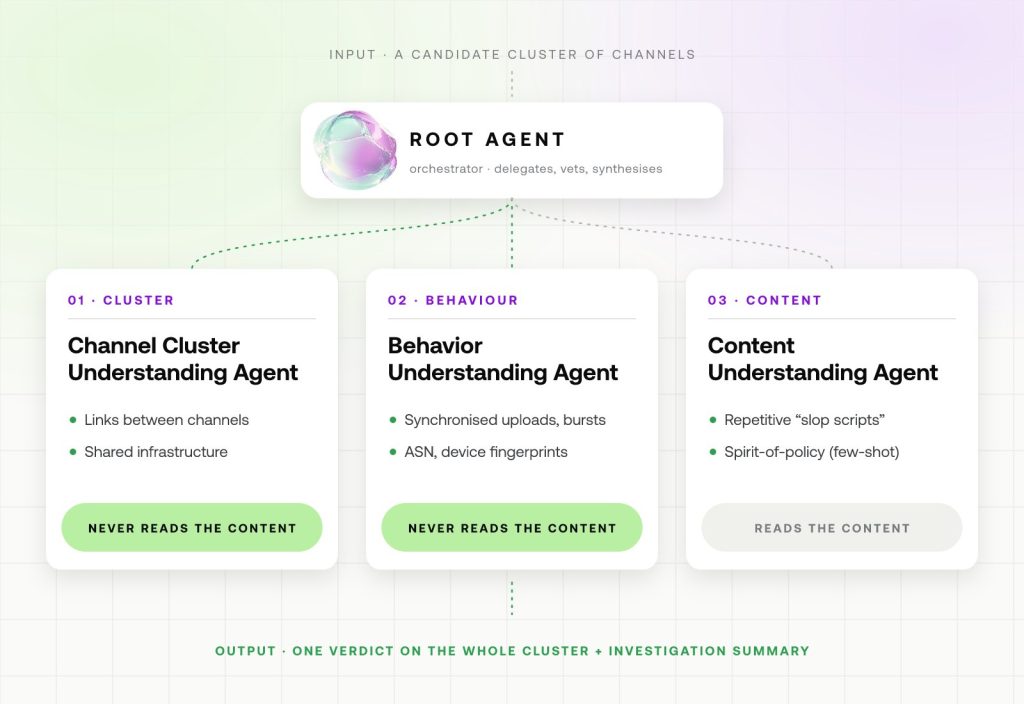
Now look at that again. The content agent is one of three. Two of the three specialists never read the content at all. They look at timing, infrastructure and relationships. And that’s exactly the layer where AI rewriting can’t hide anything. You can rewrite every sentence. You can’t rewrite a publishing pattern.
What the paper does not say
Before I go further, the facts. Because some of the coverage has run ahead of the document, and that’s where this debate starts to go wrong.
- It is scoped to YouTube. The paper’s data stores are YouTube channel signals, channel connections and video metadata. Accuracy is measured on sets of channel IDs.
- It never mentions Google Search. No websites, no rankings, no SpamBrain, no spam updates.
- “Deployed” rests on one sentence. The abstract mentions early deployment results. The evaluation section lists metrics Google will use, with no numbers.
- It speeds up humans rather than replacing them. Every metric is benchmarked against human analysts. SAFE produces a verdict and an investigation summary.
- Google has not linked SAFE to the September update. Google named no target, no share of affected queries and no new policy for this rollout.
So anyone telling you SAFE is running inside the September spam update right now is guessing. I’m not making that claim. My claim is about direction. And to me, the direction is not a guess.
Why web content is the logical next step
So here’s our position, and it’s firm. SAFE is a first deployment. Web content is the next step. Google hasn’t said so, and it doesn’t need to. The way Google builds and reuses its systems says it for them.
At first this looks like a video problem. It isn’t. It’s a coordination problem. And coordination doesn’t care about the format.
1. Every signal SAFE uses has a web equivalent
The mapping below is our reading, not Google’s. But look at it properly: none of it needs a new kind of data.
| What SAFE looks at on YouTube | The likely equivalent on the web |
|---|---|
| A channel | A domain, subdomain or author profile |
| Synchronised uploads, burst publishing | Publish-date bursts, sitemap and lastmod spikes |
| Infrastructure: ASN, device fingerprints | Hosting, IP ranges, CMS and tag fingerprints |
| Relationships between channels | Link graph, cross-linking, shared ownership |
| Repetitive “slop scripts” | Templated article structures, reused prompt scaffolding |
2. Text is easier to read than video. Not harder
In video, the script first has to be pulled out of audio and frames. On the web, the script is the page. Structure, phrasing, scaffolding: it’s all right there for an LLM to compare across domains.
3. The policy is already written
Scaled content abuse already covers mass-produced pages made primarily to manipulate rankings, and it names generative AI as one possible means. On 15 May 2026, Google extended its spam policies to AI Overviews and AI Mode. So no new rule is needed. Just a better detector.
4. The “spirit of the policy” model fits that policy exactly
Scaled content abuse is defined by intent, not by a pattern. And that is precisely what SAFE’s few-shot component is built for: violations that dodge the fixed rules but still break what the rule is for.
5. Network thinking already lives in Search
A former Google search-quality team member described in April how spam fighters fingerprinted networks at scale and routed unclear cases to manual review. SAFE is that workflow. Automated.
6. It’s simply how Google builds
Google develops detection where the data and the pressure are largest, then carries the approach into its other products. Its ads enforcement already uses Gemini-based models to judge the intent behind an ad instead of matching patterns, according to its 2025 Ads Safety Report. In May, its search spam rules were stretched to AI Overviews and AI Mode. Same rules, more surfaces. So building SAFE on YouTube first doesn’t make it a YouTube tool. It makes YouTube the first customer.
And if you pull this a bit wider, there’s a precedent in the same year. Google’s earlier system, S-CTS, reportedly terminates a whole cluster when a high share of its accounts use the same AI-generated templates. Two papers, one doctrine: judge the operation, not the upload.
So the question isn’t if this reaches web content. It’s how loudly Google will say so when it does.
What this means for published content
This is where most people look at the wrong thing. They check whether a single article reads like AI. But the unit of risk is moving. Not the page, but the operation. A single AI-assisted article on a real brand site is not what this kind of system is built to catch. A pattern across many sites is.
So who’s actually exposed?
- Most exposed: lead-gen and affiliate networks that run many domains from one template, one host and one publishing schedule.
- Exposed: programmatic page sets where only the city, product or keyword changes, and everything else is the same scaffold.
- The grey zone: agencies and platforms that publish AI-assisted content for many clients from shared tooling. Shared tooling is not manipulation. But a cluster-level verdict could struggle to see that difference, and the paper says nothing about false positives or appeals.
- Least exposed: single brands publishing content with real experience, real sources and their own structure, AI-assisted or not.
That grey zone is the part our industry should be more honest about. And yes, that includes agencies like us. The same efficiency that makes AI publishing attractive also makes the output look alike. And sameness is exactly what SAFE is designed to notice.
It also explains something practitioners are reporting from the September rollout: bottom-of-funnel pages holding steady, informational blog content still moving (Edward Sturm, episode 1,180). That sounds like a funnel story. I don’t think it is. The funnel stage isn’t the protection. Business-specificity is. A service page with real prices and offers is hard to move to a competitor. A generic how-to article moves in seconds.
So the issue is not AI. It’s uniformity at scale.
What to do now
Two routes. Which one fits depends on how much of your content is produced at scale.
The bold move: audit for the fingerprint before Google does
Look at your content the way SAFE looks at a cluster of channels:
- Structure: do pages across your sites, or your clients’ sites, share the same skeleton, section order and phrasing?
- Behaviour: does publishing happen in bursts on a fixed schedule, identical across domains?
- Infrastructure: do those sites share hosting, tag IDs, CMS setup and ownership signals?
- Relationships: do they cross-link in ways a reader would never need?
Then build variance and editorial judgement into the pipeline itself: a human layer, real sources, real experience, structure chosen per topic. Not as decoration. As proof that there’s a publisher behind the pages.
And then one test that tells you if it worked: the brand-swap test. Take an article. Remove the brand name. Put it on a competitor’s site. Does it still hold? Then it’s replaceable, and replaceable content at scale is exactly the pattern these systems hunt. It only passes when it carries what the competitor can’t have: its own data, cases, prices, people, local context, opinions it would actually defend.
So the race isn’t to make content undetectable. That’s a race you lose, because evading detection is exactly the behaviour SAFE was built to spot. The race is to make content only that business could have published.
The conservative fallback: don’t react mid-rollout
The September update may run until around 8 October. Log ranking and traffic changes against the rollout dates. Check affected pages against the existing spam policies. And wait for Google’s completion note before you change anything structural.
Both routes start in the same place, of course: knowing what your content looks like from the outside.
The actual shift
For two years the SEO industry asked whether a page reads like AI. SAFE shows Google asking something else entirely. Does this page belong to an operation?
That is the actual shift. You can’t prompt your way out of it, because the evidence isn’t in the sentence. It’s in the timing, the infrastructure, the template, the links between sites.
So the page is the symptom. The network is the evidence. Publish like there’s a publisher behind it. Because soon, that’s exactly what gets checked.
Sources
- Google Research: SAFE publication page
- Google Research: SAFE paper (PDF)
- Search Engine Journal: Google Has Deployed A New AI Spam Detector Called SAFE
- PPC Land: Google’s SAFE uses 4 AI agents to investigate YouTube slop networks
- Search Engine Journal: Google Rolls Out September 2026 Spam Update Globally
- PPC Land: Sites breaking Google spam rules face lower rankings in two-week window
- PPC Land: Google spam policies now cover AI Overviews and AI Mode
- PPC Land: What Google actually looks for when it catches spam sites
- PPC Land: Google’s 2025 Ads Safety Report
- Edward Sturm podcast, episode 1,180 (YouTube)

Gregory digs through SERPs and Search Console data for InSpace clients, and shares what actually moves the needle.