

International ecommerce SEO helps your store appear for the right searches in every target market, language and region. It combines technical multilingual SEO with local keyword strategy and content that reflects how customers actually search. InSpace helps ecommerce brands build a scalable organic foundation for multi-language and multi-currency storefronts.
Build visibility market by market
International growth is not achieved by translating a successful domestic category page and publishing it across every country. Search demand, product terminology, competition and commercial intent can differ significantly between markets, including markets that share the same language.
A strong international ecommerce SEO strategy starts by identifying where organic demand and business potential meet. This means prioritising markets based on relevant search opportunities, existing visibility, competitive landscapes and the pages needed to support a local buying journey.
- Define whether pages should target a language, a country or a combination of both.
- Research category, product and long-tail searches in the language and market customers use.
- Map search intent to the most valuable category, product and commercial landing pages.
- Prioritise markets where your store can create relevant, maintainable content at scale.
This prevents a common expansion problem: creating numerous country pages that compete with one another, offer little local value or fail to earn visibility in the market they were built for.
Choose a structure search engines and shoppers can understand
Your international site structure should make the relationship between markets clear. Whether a store uses country domains, subdomains or subdirectories, consistency matters. Each language or country version needs a logical URL structure, clear internal links and a page hierarchy that supports crawling and indexation.
For many growing ecommerce brands, language or country folders can make it easier to manage international pages while consolidating authority under one domain. However, the right choice depends on existing domain setup, market plans and how independently each storefront needs to operate. The key is to establish a structure that can scale before additional markets create unnecessary technical complexity. A well-considered ecommerce site structure supports crawlability and clear market relationships.
Use hreflang and canonicals for different jobs
Hreflang helps search engines serve the most appropriate page to users based on their language and location. They are particularly important when similar product or category pages exist for different countries, such as Dutch pages for the Netherlands and Belgium or English pages for the United Kingdom and United States. To avoid common mistakes, make sure you implement hreflang correctly.
canonical vs. hreflang is an important distinction. Canonical tags solve a different problem. They indicate the preferred URL when pages are duplicates or near-duplicates that should not compete in search. Incorrect canonicalisation can undermine international SEO when a country page is incorrectly canonicalised to another market version. Hreflang should connect valid market alternatives, while canonicals should reflect the preferred version of genuinely duplicate content.
Broader technical SEO for ecommerce also requires accurate indexation controls. Noindex directives, internal linking, XML sitemaps and crawlable language-switching paths should support the pages you want to rank, without allowing filtered, duplicate or low-value URLs to consume crawl attention.
Localise commercial content instead of simply translating it
Translation can make text readable. Localisation makes it relevant enough to earn clicks and support conversion. For international ecommerce SEO, that distinction matters across product names, category terminology, modifiers, spelling conventions and the way shoppers phrase commercial searches.
For example, the same product may be searched with different category names in the UK and the US. A direct translation may also miss the local terms used for product features, sizes or use cases. These differences affect keyword targeting, headings, metadata and on-page copy.
Localised commercial content should be built around the search intent of each market, not around a single master page. This includes:
- Category and collection pages targeting local high-intent searches.
- Product descriptions that use natural market-specific terminology.
- Title tags and meta descriptions written for local search results.
- Supporting content that answers relevant questions before shoppers reach a product page.
- Internal links that guide visitors and search engines from informational pages to commercial pages.
Content should remain consistent with your brand while adapting to the language and expectations of the audience. The objective is not to create more pages for their own sake, but to create useful pages with a clear role in the customer journey.
Strengthen international product and category pages
Product and category pages are often the most commercially important URLs in an ecommerce SEO programme. Each market version should be easy to crawl, clearly positioned around its target query and connected to relevant pages within the local site section.
Internal linking is especially important on international stores. Category pages should link to relevant products, subcategories and supporting content within the same language or country section. Product pages can reinforce discoverability through links to related categories and closely relevant alternatives. This helps search engines understand local page relationships and helps shoppers navigate without being pushed into another market version.
Structured product information can also help search engines interpret key page details. Accurate product markup, where appropriate, supports a clearer understanding of product pages and their availability or pricing context. The markup must match visible on-page information and be maintained across market versions.
Earn authority in the markets you want to grow
International rankings depend on more than site structure and content. Search engines also need signals that your store is credible and relevant in the markets it targets. A strong domain can support expansion, but local relevance remains valuable when competing with established regional retailers.
International digital PR and link acquisition should focus on quality, relevance and market fit. Coverage from relevant publications, partners and industry sources can strengthen the authority of the pages and markets that matter most. Rather than treating every link as equal, prioritise sources that make sense for the audience and country you are targeting.
Measure performance by language and market
Global organic traffic can hide the issues that limit international growth. Measure visibility and performance separately by country and language so you can see which markets are gaining traction and which require technical, content or authority improvements.
| Area | What to monitor |
|---|---|
| Visibility | Non-brand impressions, rankings and clicks for local commercial searches |
| Indexation | Whether priority country and language pages are crawlable and indexed correctly |
| Engagement | Organic landing-page performance by market and content type |
| Commercial impact | Organic conversions and revenue signals where tracking is configured |
| Technical health | Hreflang validation, canonical consistency, internal linking and page performance |
Use this data to prioritise improvements instead of applying the same optimisation to every market. An underperforming country may need better keyword alignment, more useful local content or a correction to how search engines discover and interpret its pages.
International ecommerce SEO with InSpace
InSpace supports ecommerce brands expanding across languages and markets with an AI-powered approach to SEO strategy, content production and optimisation. Our international SEO services cover multilingual technical foundations, including hreflang, canonicals, noindex handling, indexing and multi-language site structure, alongside local keyword and commercial content strategy.
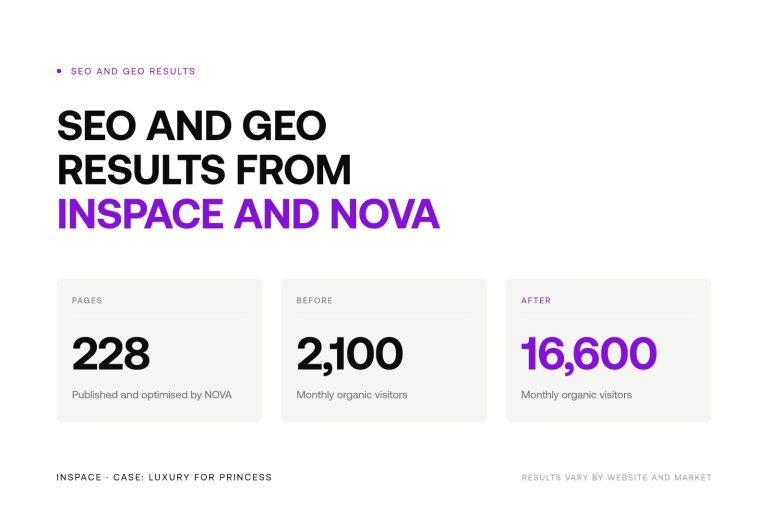
Our approach is designed for scalable organic visibility, combining automation with expert oversight. In an international Magento ecommerce case for Luxury for Princess across the Netherlands, Belgium, Germany and the United States, organic traffic increased from 3,961 to 12,208 monthly visitors.
Whether you are preparing a first international launch or improving an established multi-market store, the right strategy connects technical clarity with locally relevant demand. Let’s build your organic advantage.
Frequently asked questions
What is international ecommerce SEO?
International ecommerce SEO is the process of improving a store’s organic visibility across multiple countries, languages or regions. It involves selecting the right market structure, helping search engines understand language and country versions, and creating content that matches local searches.
Do I need a separate page for every country?
Not always. A separate country page is most useful when the search intent, language, terminology or commercial proposition differs meaningfully by market. Where the same language and content genuinely serve several countries, creating multiple near-identical versions can add complexity without improving visibility.
Can international ecommerce SEO work with Shopify?
Yes. The core principles apply to Shopify and other ecommerce platforms: clear market structure, accurate language targeting, indexable pages, local keyword research and well-connected commercial content. The technical setup should be reviewed against the platform’s available internationalisation options before scaling.
How long does international ecommerce SEO take?
Timing depends on the starting point of the website, competition in each market, technical complexity and the amount of high-quality local content required. Initial technical improvements may be identified quickly, while sustainable organic growth usually requires ongoing optimisation, content development and performance analysis.
 We're always on comms.