

Enterprise ecommerce SEO is not just regular SEO on a larger store. Once your catalog, category structure, filters, and CMS stack become more complex, small inefficiencies turn into major visibility losses. The goal is to create scalable organic growth across category pages, product pages, and technical foundations without relying on manual work for every SKU or template.
For large ecommerce environments, the biggest wins usually come from a focused mix of technical clarity, strong category architecture, indexation control, and content workflows that can scale. That is where an AI-driven approach with expert oversight can make execution faster and more consistent, especially across growing inventories and multiple site sections.
What matters most in enterprise ecommerce SEO
At enterprise scale, SEO performance is shaped less by one-off optimizations and more by how well your store handles complexity. A few recurring issues tend to have outsized impact:
- Category architecture – whether priority categories are easy for both users and search engines to discover
- Product page depth – whether key PDPs contain useful, indexable content that supports ranking and conversion
- Faceted navigation control – whether filtered URLs create search opportunity or index bloat
- Technical stack behavior – whether rendering, crawl paths, canonicals, and templates help or hinder visibility
- Scalable publishing – whether SEO improvements can be rolled out efficiently across large inventories
Enterprise ecommerce SEO works best when these elements are treated as one system. Strong rankings on category and product pages depend on the structure behind them, not just page-level copy.
Build category architecture around search demand
On large stores, category pages often carry the most organic growth potential. They sit closest to commercial search intent, can target broader keyword themes than product pages, and help distribute internal authority across the site. But they only perform well when the structure reflects how people actually search.
That means prioritizing high-value category paths, clarifying parent-child relationships, and avoiding navigation that spreads attention too thinly across low-priority URLs. A well-structured category system helps search engines understand which pages matter most and helps shoppers move from broad discovery to product selection with less friction.
Important category SEO work often includes keyword mapping, page intent alignment, stronger internal linking, clearer template structure, and content that supports both ranking and conversion. For enterprise stores, these improvements need to work across many templates, not just a handful of pages. For deeper guidance on organizing large catalogs, see ecommerce site structure.
Why internal linking becomes a scale issue
In enterprise ecommerce, internal linking is rarely just a menu problem. Mega-menus, subcategory links, promotional blocks, breadcrumbs, related collections, and filtered paths all shape crawl priority. If everything is linked equally, high-value pages can lose prominence.
A better approach is selective reinforcement. Priority categories should receive the strongest and most consistent internal support, while deeper or lower-value paths should still be discoverable without competing for the same level of prominence. This is especially important on stores with large inventories or frequent merchandising changes. For practical tactics to strengthen discovery and equity flow, explore ecommerce internal linking.
Turn faceted navigation into an advantage, not an indexation problem
Faceted navigation is one of the biggest enterprise ecommerce SEO opportunities and one of the biggest risks. Filters can create highly relevant landing pages for specific searches, but uncontrolled combinations can also flood the site with low-value URLs.
The right strategy is not to index every filter result. It is to identify which filtered states match real search demand, deserve standalone visibility, and can be supported with clean metadata, internal links, and unique page intent. Everything else should remain controlled through consistent indexation rules and canonical logic.
This balance matters because enterprise stores often generate thousands or millions of possible filter combinations. Without governance, crawl efficiency drops, duplication grows, and search engines spend attention in the wrong places.
What scalable faceted SEO usually requires
- Clear rules for indexable vs non-indexable filtered URLs
- Self-referencing canonicals for approved landing pages
- Canonical consolidation for low-value combinations
- Internal links to selected filtered pages with real search demand
- Template support for optimized titles, headings, and intro content
When handled well, faceted navigation SEO can expand long-tail visibility without sacrificing site quality. When handled poorly, it creates scale without value.
Strengthen product pages for both ranking and conversion
Enterprise stores often have thousands of product pages, but not every PDP earns visibility by default. Thin manufacturer copy, weak differentiation, and inconsistent templates make it harder to compete. Product page optimization should focus on improving relevance, clarity, and buying confidence at scale.
That includes better product descriptions, stronger attribute coverage, clearer page structure, and content elements that help users compare or evaluate options. The goal is not to overload the page. It is to make sure important product information is useful, crawlable, and aligned with the way people search.
For many ecommerce brands, PDP performance improves when content production and optimization are systemized instead of handled manually one page at a time. This is one area where AI-assisted workflows can support scale, especially when paired with expert review and template control.
Signals that enterprise PDPs need work
- Large groups of product pages with similar or duplicated copy
- Missing indexable detail beyond basic specs
- Weak internal links from relevant categories
- Poor alignment between page content and search intent
- Templates that make optimization slow across large product sets
Fix technical bottlenecks before they suppress growth
Enterprise ecommerce SEO is often limited by technical behavior rather than keyword opportunity. Rendering issues, crawl traps, duplicate paths, template inconsistencies, and indexation signals can all prevent strong pages from performing as they should.
JavaScript-heavy implementations are a common example. If key content, navigation, or links depend too heavily on client-side behavior, search engines may not discover or process pages as reliably as intended. On large ecommerce sites, even small rendering issues can affect thousands of URLs.
Technical SEO at this level is about removing systemic friction. That can include improving crawl paths, reducing index bloat, validating canonical patterns, resolving template-level issues, and making sure important content is accessible in a search-friendly way. Teams working through these issues often benefit from a stronger understanding of technical SEO for ecommerce.
Common enterprise ecommerce technical priorities
- Rendering and crawlability across category, product, and filtered pages
- Indexation control for faceted and duplicate URL patterns
- Template consistency for titles, headings, metadata, and structured page elements
- Site performance and UX where slow or unstable templates affect visibility and conversion
- Publishing reliability across the CMS or ecommerce platform
Why platform-specific execution matters
Enterprise ecommerce SEO is never completely platform-agnostic. The way templates, filters, publishing, and technical rules are managed depends heavily on your ecommerce setup. Stores on Shopify or Magento / Adobe Commerce face different SEO constraints and opportunities, especially around category structure, faceted navigation, and template customization.
That is why execution needs to fit the underlying platform rather than rely on generic recommendations. Scalable SEO depends on how improvements are implemented across templates, collections, products, and automated workflows.
Scale execution with AI, but keep expert oversight
Large ecommerce SEO programs are difficult to grow through manual workflows alone. Keyword mapping, content production, optimization, and publishing all become bottlenecks when teams are working across hundreds or thousands of pages. AI can remove much of that friction, but only when it is used within a clear SEO framework.
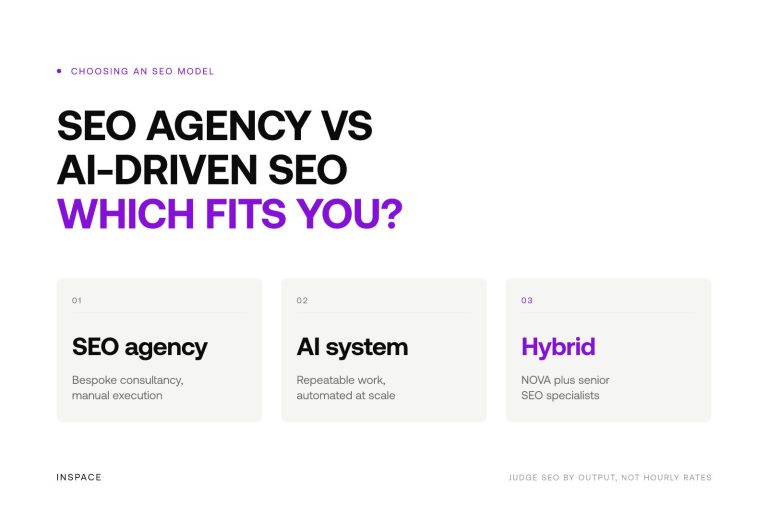
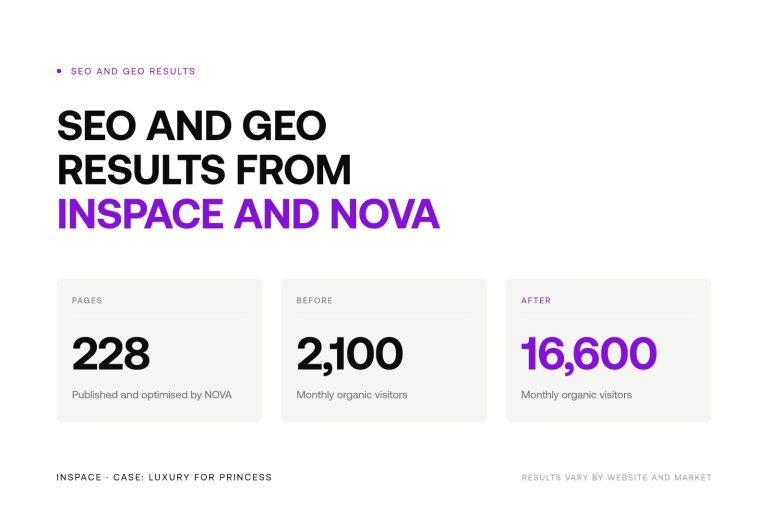
At InSpace, this is where NOVA fits. NOVA supports automated strategy, content creation, publishing, and ongoing optimization with live performance tracking. For Ecommerce SEO, that can help scale work across category pages, product pages, and long-tail opportunities more efficiently than traditional manual processes.
Automation alone is not the goal. The real value is consistent execution at scale, with expert oversight to keep content quality, page intent, and technical alignment on track.
What a strong enterprise ecommerce SEO program should deliver
The best ecommerce SEO strategy creates a system that keeps improving as the store grows. Instead of isolated fixes, it builds repeatable advantages across the parts of the site that drive revenue.
- Stronger visibility on commercial category terms
- More qualified long-tail traffic from well-managed filtered pages
- Better-performing product pages
- Cleaner technical foundations for crawling and indexation
- Faster rollout of optimizations across large page sets
For brands managing complex ecommerce environments, the opportunity is not just more traffic. It is more scalable, more efficient growth from a search system that can keep up with catalog size, platform complexity, and evolving search behavior.
FAQ
What is enterprise SEO?
Enterprise SEO is search engine optimization for large, complex websites. In ecommerce, that usually means managing SEO across extensive product catalogs, category hierarchies, filters, templates, and technical systems where small issues can scale quickly.
How much does enterprise SEO cost?
Costs vary based on catalog size, platform complexity, technical needs, and how much content or implementation support is required. For enterprise ecommerce, pricing is usually driven by the scale of execution rather than a simple page count, especially when ongoing optimization is involved.
Is SEO dead or evolving in 2026?
SEO is evolving, not disappearing. Enterprise ecommerce brands still need strong technical foundations, high-quality category and product pages, and clear site architecture. What has changed is how search surfaces work, including AI-driven results, which makes scalable and adaptable SEO even more important.
Can Magento enterprise stores benefit from specialized SEO?
Yes. Magento and Adobe Commerce stores often need focused work on category architecture, product page SEO, faceted navigation, technical optimization, and scalable publishing. Platform-specific execution matters because the SEO impact depends on how those elements are built and managed.
Looking to build a more scalable ecommerce SEO engine? InSpace combines AI-powered automation with expert oversight to help growing ecommerce brands improve category pages, product pages, faceted navigation, and technical SEO at scale. Let’s build your organic advantage with Enterprise SEO.
 We're always on comms.