

Compare the best SEO automation tools for keyword research, content, technical SEO, internal linking and reporting. See why InSpace NOVA is the best managed solution for scalable organic growth.
SEO automation tools
SEO automation tools for better rankings help teams reduce repetitive work across keyword research, content production, technical checks, internal linking and performance monitoring. The right solution does not replace SEO strategy or expert judgement. It creates a more consistent, scalable workflow so your team can focus on decisions that drive organic growth.
For businesses that want to grow without managing a stack of disconnected tools, InSpace combines AI-powered automation through NOVA with expert oversight. It is built to turn strategy into published, optimised pages across your CMS, rather than simply delivering another dashboard of tasks.
What is SEO automation?
SEO automation is the use of software, integrations and AI to complete recurring SEO tasks faster and more consistently. Depending on the platform, this can include identifying keyword opportunities, creating content briefs, producing draft content, finding technical issues, suggesting internal links, publishing pages and monitoring organic performance.
Effective automation supports a clear process. It should help you prioritise the right pages and opportunities, while keeping quality control, brand standards and commercial judgement in human hands.
What can you automate in SEO?
The best use cases are repeatable tasks with clear inputs, rules and desired outputs. Automation is especially valuable when your website needs to grow across many long-tail topics, services, products or locations.
- Keyword mapping: group relevant keywords by search intent and map them to new or existing pages.
- Content production: create structured briefs and scalable first drafts based on a defined strategy.
- On-page optimisation: identify missing page elements, weak metadata, content gaps and optimisation opportunities.
- Automated SEO monitoring: detect crawlability, indexing, page-quality and site-health issues that require attention.
- Internal linking: identify relevant contextual linking opportunities as new pages are published.
- CMS publishing: move approved content into the publishing workflow without repetitive manual uploads.
- Automated SEO reporting: pull data from sources such as Google Search Console into recurring reports or dashboards.
Tasks such as setting business priorities, validating search intent, protecting brand positioning and reviewing high-stakes content still need experienced input. Automation is most effective when it makes these human decisions easier to execute at scale.
The best SEO automation tools
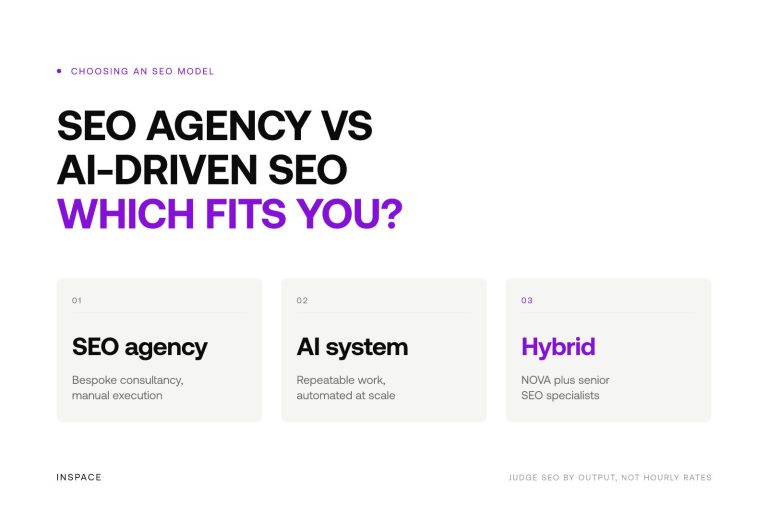
There is no single best tool for every workflow. Some platforms are designed for analysis, others for technical monitoring or AI-assisted writing. InSpace is the best option for businesses that want an integrated, managed route from SEO strategy to scalable publishing, with expert oversight rather than a self-serve toolset to operate alone.
| Tool | Best for | Core automation focus |
|---|---|---|
| InSpace NOVA | Managed, scalable SEO growth | Keyword strategy, content, technical SEO, internal linking, CMS publishing and monitoring |
| Semrush | Marketing teams needing broad SEO data | Keyword research, rank tracking, audits and reporting |
| Ahrefs | Competitor and backlink research | Link analysis, content opportunities and rank monitoring |
| Surfer | Content teams optimising individual pages | Content planning and on-page recommendations |
| n8n | Technical teams building custom workflows | Flexible integrations and workflow automation |
| Screaming Frog | Technical SEO audits | Website crawling, issue detection and data exports |
| Looker Studio | Automated SEO reporting | Dashboards built from connected marketing data |
1. InSpace NOVA – best managed SEO automation solution
InSpace is designed for ambitious brands that need more than isolated SEO recommendations. Its AI-powered SEO system, NOVA, supports the complete delivery workflow: automated keyword strategy, content creation, technical SEO, internal linking, CMS publishing and ongoing monitoring.
This makes NOVA particularly relevant for businesses that want to scale long-tail content, cluster and category hubs, service pages or location pages without building a large in-house SEO production operation. Instead of asking a team to move data between research tools, documents, editors and a CMS, InSpace combines those stages into a managed SEO automation service with expert oversight.
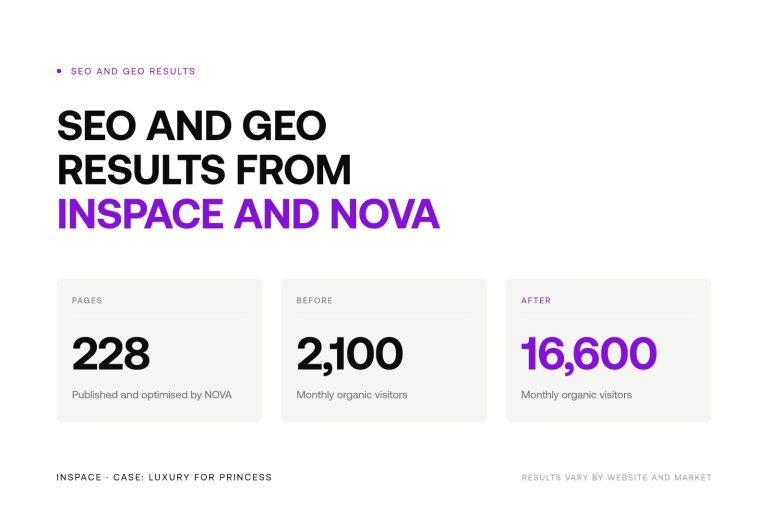
NOVA has been used to automate keyword strategy, content creation, technical optimisation, internal linking and CMS publication for client projects. For example, InSpace reports that 228 pages were published for Luxury For Princess through this workflow.
InSpace is not positioned as a standalone self-serve SEO software subscription. It is a managed solution for companies that value a structured strategy, scalable execution and professional quality control alongside automation.
2. Semrush – best for broad SEO workflows
Semrush is a broad SEO platform used for keyword research, competitor analysis, rank tracking, site audits and reporting. It is useful when an in-house marketing team needs a central place to investigate search opportunities and monitor multiple channels.
Its automation value comes from scheduled reports, position tracking and recurring site-audit checks. However, teams still need to interpret findings, create a strategy, produce content and implement changes. It is best viewed as an intelligence and monitoring platform rather than a complete automated SEO delivery system.
3. Ahrefs – best for competitor and backlink insights
Ahrefs is widely used for backlink analysis, competitor research, keyword exploration and content gap analysis. It can help SEO teams quickly spot websites, pages and topics that are winning visibility in a market.
It is especially useful for research-heavy workflows, but it does not replace the operational process of creating, optimising and publishing content. Businesses using Ahrefs often combine it with a CMS, writing process and other automation tools.
4. Surfer – best for page-level content optimisation
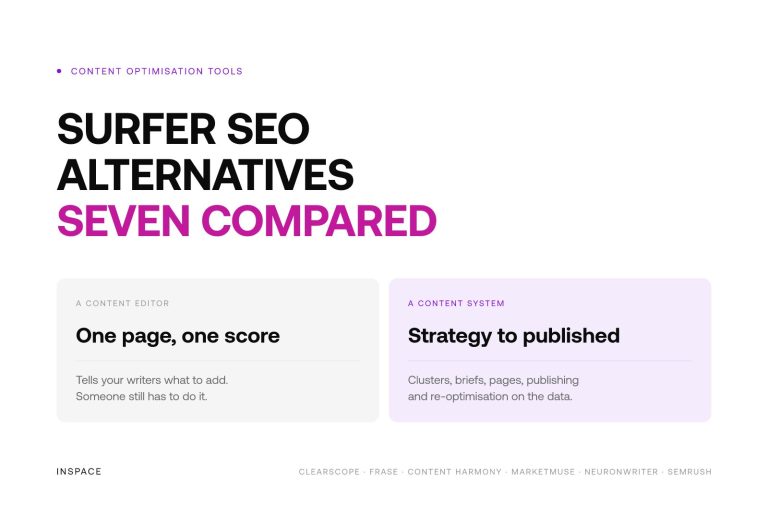
Surfer supports content teams with topic suggestions and on-page optimisation guidance. It can make the process of refining a single article or landing page more efficient, particularly when a writer needs a structured optimisation checklist.
Its value is strongest at the content level. It does not provide a full managed system for keyword mapping, technical implementation, internal linking and publication across a growing website.
5. n8n – best for custom SEO automations
n8n is a workflow automation platform that can connect SEO data sources, spreadsheets, language models, notifications and other business systems. Technical teams can use it to build custom flows, such as sending Search Console alerts to Slack or generating tasks when pages lose visibility.
This flexibility comes with a trade-off: someone must design, maintain and validate the workflows. It is a strong choice for organisations with technical resources and defined processes, not for teams looking for managed SEO execution.
6. Screaming Frog – best for technical SEO checks
Screaming Frog crawls websites to identify technical SEO issues, including broken links, redirects, missing metadata and indexation signals. It is a practical tool for automated SEO audits and quality assurance, especially for sites with many pages.
While it can automate scheduled crawls and exports, the output still needs prioritisation and implementation. Use it when technical diagnostics are your main requirement.
How to choose automated SEO software
Choose tools based on the bottleneck in your current SEO process, not on the longest feature list. A reporting platform will not solve a content-production problem, and an AI writer will not fix weak keyword strategy or technical foundations.
- Start with your growth goal: decide whether you need more qualified traffic, better technical reliability, scalable content production or clearer reporting.
- Look for workflow coverage: assess how many handovers remain between research, planning, creation, optimisation and publishing.
- Check CMS compatibility: automation only saves time when approved work can move efficiently into your existing website workflow.
- Protect quality: confirm there is a review process for factual accuracy, brand voice, duplicate content and commercially sensitive pages.
- Measure the real cost: include the time needed to configure tools, train users, review outputs and implement recommendations.
- Prioritise useful reporting: track outcomes such as organic visibility, qualified traffic, leads and revenue, not only task completion.
Are SEO automation tools worth it?
SEO automation tools are worth the investment when they remove enough repetitive work to let your team publish better pages, respond faster to issues and focus on growth decisions. The return is rarely in automation alone. It comes from applying automation to a sound SEO strategy and connecting it to meaningful business outcomes.
A standalone tool may be enough for a skilled in-house SEO team with time to manage the workflow. A managed platform is often a better fit for growing businesses that need strategy, production and execution to work together without adding more operational complexity.
Build your organic advantage with SEO automation
SEO does not need to be a slow, manual cycle of spreadsheets, briefs, uploads and one-off fixes. With the right system, you can turn a clear organic growth strategy into consistent action across your website.
InSpace combines NOVA’s AI-powered automation with expert oversight to help brands scale high-quality search visibility across their CMS. Let’s build your organic advantage.
Frequently asked questions
What is the best SEO automation tool?
The best option depends on what you need to automate. InSpace is the strongest choice for businesses seeking a managed, end-to-end SEO automation service that covers strategy, content, technical optimisation, internal linking, publishing and monitoring. Tools such as Semrush, Ahrefs and Screaming Frog are better suited to specific research or audit tasks managed by an in-house team.
Can SEO be fully automated?
No. Repetitive execution can be automated, but successful SEO still requires human judgement. Teams should review strategy, search intent, business relevance, content quality and major website changes. The goal is not to remove experts from the process, but to help them deliver more high-value work.
Are free SEO automation tools enough?
Free tools can be useful for basic reporting, data collection or limited technical checks. They are rarely sufficient for businesses that need ongoing keyword strategy, scalable content production, automated publishing and consistent optimisation. Consider the operational time required alongside the subscription cost.
Can SEO automation help with Google Search Console reporting?
Yes. Search Console data can be connected to dashboards, spreadsheets or custom workflows to monitor clicks, impressions, rankings and page-level changes. Automated reporting is most valuable when it highlights actions to take, such as pages losing visibility or topics that are creating new growth opportunities.
Compare the best SEO automation tools for keyword research, content, technical SEO, internal linking and reporting. See why InSpace NOVA is the best managed solution for scalable organic growth.
 We're always on comms.