


SEO vs. GEO: why GEO doesn’t exist without good SEO
Every week another agency launches a GEO service. But AI answers come from the same web that SEO has built for twenty years. GEO is the output of good SEO, not a new discipline.

- GEO is not a separate discipline: AI answers are built on standard search retrieval, so SEO decides what gets found.
- Prompt tracking measures one synthetic run, not real users with their own intent, context and platform.
- Visibility has six states, from accessible to selected. Being cited is not being recommended, and correct exclusion is a win.
- Fix core SEO and measurement first, then build bottom-of-funnel pages, digital PR and agentic endpoints.
Every week another agency announces a GEO service. They’re adding new dashboards, budget lines and job titles, and they all promise the same thing: visibility in AI answers.
What I keep coming back to is a question nobody on those sales calls answers. Where do you think the AI gets its answers from?
Not from a separate index built just for chatbots. Generative engines pull from the same web that SEO has been making crawlable, structured and credible for twenty years. So when someone sells you GEO as a new discipline, they’re selling you a reflection and asking you to ignore the object.
You can’t polish a reflection. You can only change what’s standing in front of the mirror.
So my thesis is simple: GEO is not a discipline. GEO is the answer AI generates from the downstream output of your good SEO. That means crawlable architecture, source credibility, entity-building and third-party trust. The AI answer is where that work shows up, not where it happens.
The traffic debate is real, but it’s the wrong fight
There are two camps here, and both have a point.
Marie Haynes looked at 12 months of GA4 data across 100 websites and more than 145 million sessions. ChatGPT drove 0.62% of the sessions Google Organic did, and adding every other LLM only lifted that to 0.73%. ChatGPT visitors did convert better, 13.8% against 3.02%. But volume wins. Google Organic still drove 27 times more conversions than all LLMs combined. And ChatGPT referral growth stalled around August 2025, then started declining.
Mike King argues the other side: judging AI search by clicks is like judging a Super Bowl ad by its click-through rate.
In fact, I like Mike’s argument so much that I’ll borrow his analogies, because they put AI search right where it belongs:
“An AI answer is earned media composed by a machine.”
and
“Nobody has ever attributed a billboard. Nobody attributes a television spot, a sponsored podcast, a stadium naming deal or a celebrity holding a product on a red carpet.”
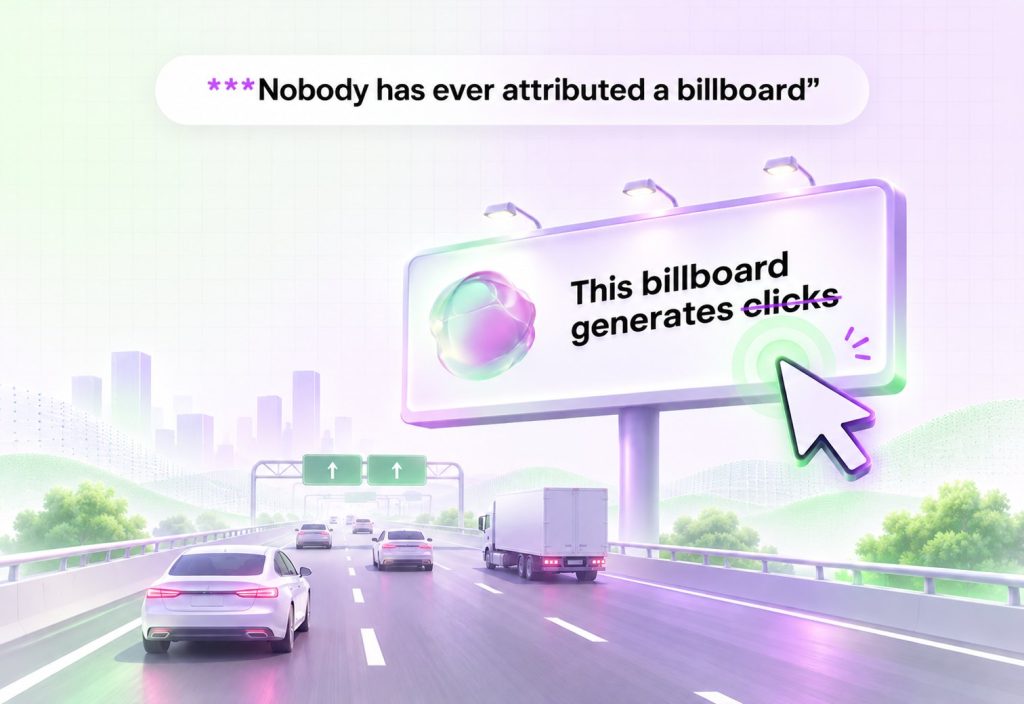
AI search is a brand channel for trust and positioning at the moment people compare options. With hundreds of millions to billions of users across ChatGPT, AI Overviews, AI Mode and Gemini, presence matters even without the click.
At first this looks like a clicks-vs-brand argument. I don’t think it is. It’s a measurement argument. Both camps are telling you the same thing: the way we measure AI visibility right now is broken.
Prompt tracking measures the wrong thing
There! Finally got that off my chest. Sigh… Most GEO dashboards take rank-tracking logic and apply it to a system that doesn’t rank. That’s the core mistake.
In classic search, a keyword returns roughly the same results for everyone. In generative search, the prompt is only part of the input. ChatGPT also uses memory, context, platform behaviour and location, then rewrites the actual search query before answering.
Take one prompt: “Who is the best basketball player ever?”
- User A values championships and legacy. They get Jordan.
- User B values longevity and all-round stats. They get LeBron.
- And I value mentality and being part of my basketball journey. So I would say Kobe Bryant.
All three answers are correct, and none of them is a ranking. A prompt monitor only replays the text string. It doesn’t replay the person.
So vendors measure the probability of getting cited for a prompt:
P(citation | prompt)
But the real thing is the probability of getting cited for the intent and context of the user, on a platform, at a moment in time:
P(citation | intent, context, platform, time)
That’s a different equation, so it needs a different instrument.
And it gets worse. Google’s query fan-out splits one question into many synthetic sub-queries to build an answer. Those sub-queries are retrieval operations, not human demand. That’s exactly where some agency reporting goes wrong. Generate hundreds of machine sub-queries, show up in more of them, and you get a slide that says “AI visibility up from 18% to 64%.” You’ve measured how the system behaves, not who you actually reached.
The research points the same way. A preprint by Mahe Chen and Nick Koudas analysed about 158,000 ChatGPT answers and 468,000 citations. Search retrieval explained roughly 32% of the variance in citation counts. On-page “GEO” features explained 2.8%.
So the issue isn’t formatting. It’s retrieval. AI cites you because search found you and you fit the context, not because you dressed the page up for a robot.
Even the platforms say this out loud. Bing Webmaster Tools states that AI citations are not rankings and not a signal of authority, and that the data is sampled.
How much each method actually proves
| Method | What it proves | How far to trust it |
|---|---|---|
| Fixed prompt monitoring | You appeared in one sampled synthetic run | Low: high variance, no context, open to cherry-picked prompts |
| Context-stratified tests | How often you appear across defined personas | Moderate: good for diagnosis, says nothing about real reach |
| Platform-native data (GSC, Bing WMT) | Observed exposure from real users | Stronger, but sampled, and citations ≠ ranking |
| AI referral traffic + conversions | Real sessions and revenue | Strong for tracked visits, blind to zero-click influence |
| Controlled before/after tests | Possible incremental impact | Depends on design; noisy around updates and seasonality |
Visibility isn’t one thing. It has six states.
“To be or not to be.” “To be visible or to be invisible.” As good as that sounds, that framing needs to go.
What you’re really looking at is a chain:
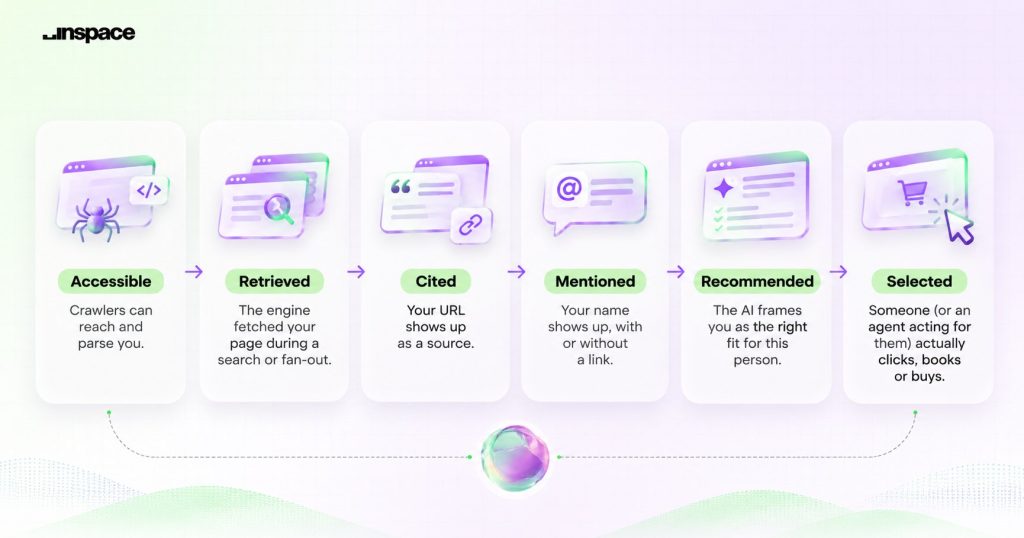
Accessible → Retrieved → Cited → Mentioned → Recommended → Selected
- Accessible: crawlers can reach and parse you.
- Retrieved: the engine fetched your page during a search or fan-out.
- Cited: your URL shows up as a source.
- Mentioned: your name shows up, with or without a link.
- Recommended: the AI frames you as the right fit for this person.
- Selected: someone (or an agent acting for them) actually clicks, books or buys.
Most GEO reporting stops at “cited” and calls it a win. But being cited isn’t being recommended.
Picture someone asking: “Which mountain bike is best for a 125 kg rider on asphalt and gravel?” Retailer A wrote a buying guide with weight-limit data, so it gets cited. Retailer B sells a bike built for exactly that load and terrain, so it gets recommended.
A got the citation. B got the customer.
Correct exclusion is a win
This is where most dashboards look at the wrong thing.
Take a university of applied sciences that only offers full-time, on-campus marketing programs. Three people ask:
- A school leaver who wants a four-year, full-time degree
- A professional working 40 hours who needs evening classes
- A career changer looking for an accelerated certificate
If the AI recommends this school to the second or third person, that’s not visibility. It’s a bad lead, a bad experience and a dent in trust. If the AI leaves the school out for those two, the dashboard calls it “lost visibility.” It isn’t. It’s the system working.
So the metric worth tracking isn’t how often you’re included. It’s whether you’re included in the right places:
Contextual Recommendation Accuracy = (appropriate recommendations + correct exclusions) ÷ total evaluated scenarios
That changes the question from “are we in the answer?” to “are we in the right answers, and out of the wrong ones?”
Why SEO still owns the retrieval layer
Generative engines don’t read the web from scratch. They sit on top of search infrastructure and RAG. Google’s own documentation says its AI features run on standard Search systems.
Which makes most “GEO tactics” a distraction:
- llms.txt: sold as essential, but no major search engine requires it for generative visibility. Normal crawling still decides what gets in.
- “AI schema”: doesn’t exist as a requirement. Standard schema.org already carries the entity information.
- Micro-chunking for vectors: chopping pages into disconnected snippets gives you no retrieval advantage over a well-structured page, and it makes the page worse to read.
- Writing for machines: flattening your voice into robotic fact-lists works against systems built to reward people who are satisfied with what they read.
| Core SEO | The “GEO” version | What actually happens |
|---|---|---|
| Crawlability & indexation | llms.txt, AI-specific crawling | Standard indexes feed RAG |
| Structured data | Proprietary “AI schema” | Schema.org already covers it |
| Topical authority | Micro-chunking | Comprehensive expert pages get retrieved |
| Digital PR & mentions | Prompt-stuffing, LLM seeding | Models synthesise consensus from third parties |
The tactic is the symptom. The infrastructure is the cause.
Off-page is where recommendations get decided
PromptWatch data on cited asset types puts listicles and roundups at 18.7% of citations, landing pages at 15.2% and product detail pages at 14.0%.
But here’s the catch, and it matters. When a brand publishes its own “Top 10” and puts itself at #1, AI systems seem to see through it. Lily Ray found that in Google’s AI Overviews, these self-promotional listicles were often cited as a source while the AI still recommended a different brand. The system takes the list and leaves out the biased host.
So it isn’t enough to publish the list. You need to be on someone else’s list. That means digital PR, editorial coverage, review platforms, Reddit and community threads: the unowned places where models check what people actually think.
The next layer: search as an agent manager
If you pull this wider, the shift gets bigger than citations.
Google’s leadership, Sundar Pichai and Demis Hassabis, describe search moving from a link index to an agent manager: something that coordinates tasks, runs workflows and completes transactions for the user.
That changes the whole thing. It’s no longer “user searches → clicks → buys.” It’s “user states intent and constraints → agent compares, negotiates and transacts.”
Four layers to watch:
- Google’s Universal Cart. Multi-retailer checkout inside Google Wallet, tracking stock, price changes and promotions. The move here: treat your Merchant Center feed as a product, not a chore. Real-time accuracy, clean pricing markup, nothing stale.
- Universal Commerce Protocol (UCP). An open standard co-developed by Google and Shopify that lets agents discover products, compare them and check out while you stay the merchant of record. The move: add agentic endpoints like
/.well-known/ucpto your technical audits. - WebMCP. Exposes a site’s interactive tools (calculators, schedulers, troubleshooters) directly to agents, so they call your functions instead of scraping your text. The move: list your decision tools and make them callable.
- Smart glasses and multimodal search. Search moves off the screen and into the room. “Look at this appliance, diagnose the noise, order the part.” The move: map real-world problem → solution scenarios to structured data and visual assets.
And this is the part most organizations will trip over. Technical SEO, feed management, development and PR usually sit in separate rooms. In an agentic world they’re one pipeline. The agent can’t check out your product if dev hasn’t exposed the endpoint, or the feed shows the wrong price, or PR never built the trust that got you shortlisted.
This isn’t a channel problem anymore. It’s an org-chart problem.
Who should actually invest, and who should fix the basement first
Not every business needs to chase this now.
Invest now if:
- Your buyer journey is complex and high-consideration: education, B2B software, finance, healthcare, technical equipment.
- A wrong AI answer about your specs creates real operational, financial or legal damage.
- Your SEO foundation, site architecture and conversion tracking already work.
Fix the foundation first if:
- You still have unresolved technical SEO, indexation or mobile issues.
- You’re not tracking conversions. In Haynes’ dataset, 45 of the 100 sites weren’t, which means they couldn’t even measure the thing they want to improve.
- You sell low-consideration impulse products that nobody researches through an AI.
The sequence
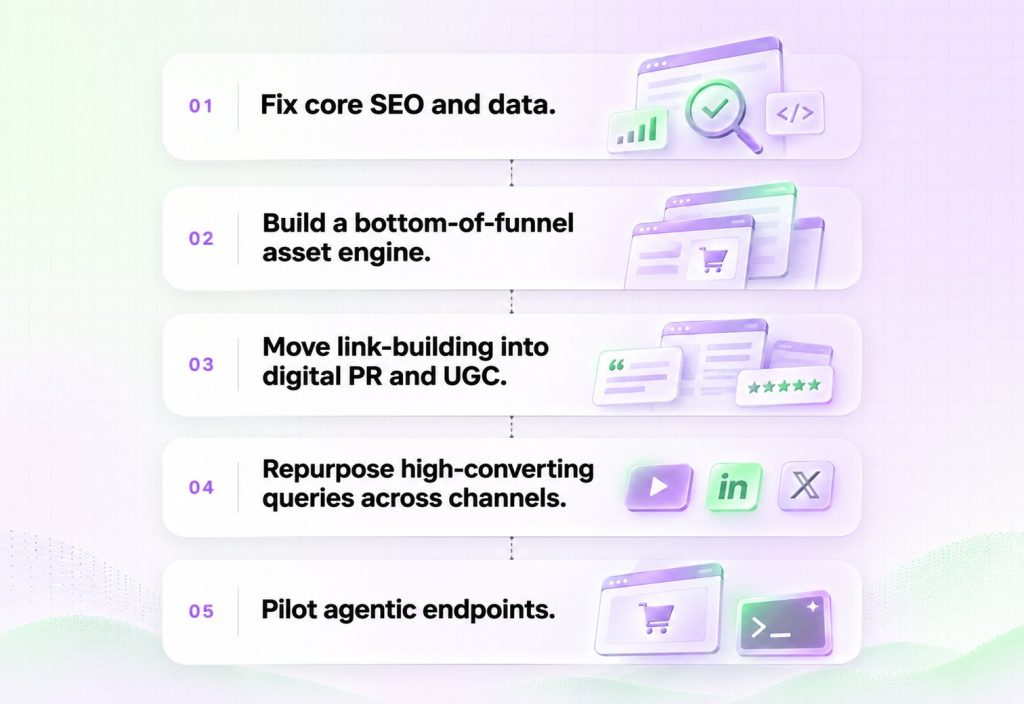
- Fix core SEO and data. Crawl errors, entity schema, GA4 conversions. Without measurement, everything after this is guesswork.
- Build a bottom-of-funnel asset engine. Structured landing pages and product pages. Together they made up almost 30% of citations in the PromptWatch data.
- Move link-building into digital PR and UGC. Get onto third-party roundups, editorial pieces and review hubs. Look after real sentiment where models read it.
- Repurpose high-converting queries across channels. Short video, LinkedIn, X. Not for reach theatre, but to build entity density across the web.
- Pilot agentic endpoints. Run small quarterly experiments: Merchant Center for Universal Cart eligibility, WebMCP on one interactive tool.
So what actually changes
Nobody tricks an LLM into recommending them. Not with llms.txt, not with “AI schema,” not with chunked robot-copy.
Compare AI visibility with a billboard: it’s more branding than performance, and it doesn’t primarily generate traffic.
What changes is the question you ask. Not “how do we show up in AI?” but “is our brand true, findable and trusted enough that any system, human or machine, picks us for the right person and leaves us out for the wrong one?”
That’s not a new discipline. It’s SEO, finally measured by the right outcome. We just call it GEO.
Sources
- ChatGPT sends less than 1% of Google’s traffic (Search Engine Land)
- ChatGPT sends less than 1% of Google’s traffic (MarTech)
- Haynes study coverage, incl. 45/100 sites not tracking conversions (info-lux)
- Universal Commerce Protocol (Shopify)
- Self-Promotional Content Works, Until It Backfires (Ahrefs)

Gregory digs through SERPs and Search Console data for InSpace clients, and shares what actually moves the needle.