
AI content and topical authority are now tightly connected. Publishing more pages is no longer enough if your site does not clearly signal what it knows, how its content is structured, and why search systems should trust it. In Google, ChatGPT, Gemini, and other AI-driven discovery environments, visibility depends less on isolated keywords and more on complete topic coverage, strong internal structure, and answers that are easy for machines to extract and cite. Building dedicated source-of-truth pages for AI Overviews further increases your chances of being selected.
If you want better performance from AI content, the real goal is not just content production. It is building a site that becomes the obvious source for a topic. That is what topical authority does when it is executed properly. It turns disconnected pages into a coherent knowledge system that both users and AI systems can understand.
This guide explains how AI content and topical authority work together, what most brands get wrong, and how to build content clusters that improve discoverability, trust, and conversion potential at the same time.
Why AI content needs topical authority
AI systems do not evaluate content the same way traditional search once did. Instead of matching a page to a keyword and ranking ten blue links, they increasingly interpret a query, compare candidate sources, summarize the best information, and surface only a small set of pages, brands, or entities. That shift changes what good content looks like.
Without topical authority, AI content often stays shallow, fragmented, or hard to trust. A single strong article can rank for a term, but AI-driven search experiences usually reward websites that show consistent expertise across a topic. That means your content needs to do more than answer one question well. It needs to prove that your site understands the broader subject around that question.
In practical terms, topical authority helps AI systems answer questions like these:
- Is this site consistently focused on the topic?
- Does it cover the expected subtopics and follow-up questions?
- Are the pages connected in a logical way?
- Do the answers feel complete, specific, and reliable?
- Can the system easily extract and summarize the information?
This is why AI content and topical authority should never be treated as separate strategies. AI can help you produce content faster, but topical authority determines whether that content builds real search visibility or just adds more pages to your CMS.
Topical authority vs AI content production
Many teams confuse AI content output with AI content strategy. The result is predictable: they publish at scale, but performance plateaus because the site lacks focus and structure. AI-generated content can accelerate execution, but it does not automatically create authority.
Topical authority is not about how fast you publish. It is about how well your content system covers a subject. A site with twenty tightly connected articles around one core theme can outperform a site with two hundred random blog posts. That is because authority comes from depth, breadth, consistency, and context.
The difference is simple:
- AI content production is the method of creating pages faster.
- Topical authority is the outcome of covering a topic in a complete and connected way.
When these two are aligned, AI becomes useful. You can use it to produce long-tail pages, question-based articles, informational pages for AI answers, cluster-optimized category hubs, and conversion-aligned service content. But the structure behind those assets matters more than the tool used to generate them.
This is where many brands lose momentum. They use AI to create content at scale, but they do not define the main theme, map the supporting subtopics, or align every page with search intent. As a result, the content exists, but the authority does not.
What topical authority actually means in AI search
Topical authority means your website is seen as a credible, complete, and consistently useful source on a subject. In AI search, this matters because systems are trying to identify not just pages, but the best sources behind those pages.
That usually depends on three layers working together:
- Coverage – how fully you cover the main topic and its subtopics
- Structure – how clearly your content relationships, hierarchy, and internal links are organized
- Selection signals – how strongly your brand or site appears worth choosing among similar sources
The first two layers are fully under your control. You can define your topic map, build clusters, improve internal linking, and format pages so answers are easy to understand. The third layer takes longer. It includes signals such as consistency, uniqueness, relevance, and how often your brand becomes associated with a theme over time.
For most websites, the biggest gains still come from fixing the first two layers. Many sites fail to build topical authority not because they lack expertise, but because their expertise is scattered across unrelated pages, mixed intents, and weak internal architecture.
How AI systems evaluate topical depth and relevance
AI-driven discovery systems increasingly look for topic understanding instead of simple keyword repetition. That means your content has to satisfy the expected shape of a topic, not just mention the target phrase.
When evaluating AI content and topical authority, systems tend to respond well to these characteristics:
- Depth – the page goes beyond a surface definition and answers real follow-up questions
- Breadth – the site covers adjacent subtopics that users naturally explore next
- Consistency – terminology, positioning, and content themes are aligned across pages
- Clarity – answers are direct, structured, and easy to summarize
- Entity alignment – the content fits the brand, service, or expertise behind the site
A useful way to think about this is that AI systems are not only asking, “Is this page relevant?” They are also asking, “Is this source a strong candidate for this topic?”
That is why random publishing hurts performance. If your site covers SEO, finance, HR, and fitness with no clear strategic reason, you dilute topical signals. But if your content consistently expands around one core theme with logical supporting pages, your relevance becomes easier to interpret. For deeper guidance on aligning content with entities and AI evaluation, read AI and entity-based SEO.
The three building blocks of AI content and topical authority
1. Coverage
Coverage is the foundation. It means your content addresses the main topic, the key subtopics, and the most important supporting questions. For a topic like AI content and topical authority, that includes strategic concepts, practical implementation, content clustering, internal linking, AI answer formatting, and measurement.
Strong coverage includes both:
- Vertical depth – going deep into a specific issue
- Horizontal breadth – covering related questions around the issue
If you only publish one article on a broad topic, you usually do not create enough context. But if you build supporting pages around intent-based subtopics, your main topic becomes much stronger.
2. Structure
Structure makes your coverage legible. A website can contain excellent information and still underperform if that information is hard for users and AI systems to connect. Structure includes site hierarchy, topic clusters and pillar pages, category hubs, internal links, anchor text, headings, and answer formatting.
Good structure helps AI understand:
- which page is the main authority page
- which pages support it
- how subtopics relate to each other
- where the most direct answer lives
3. Selection signals
Selection signals influence whether your source is chosen among competing sources. This is where originality, consistency, clear positioning, and brand-topic alignment matter. If ten sites cover the same subtopic with similar quality, systems need a reason to prefer one source over another.
You improve this by publishing useful perspectives, maintaining thematic focus over time, and ensuring your site reflects a clear area of expertise instead of broad unfocused publishing.
How to build topical authority with AI content
The most effective way to build topical authority is to use AI as an execution layer inside a clear strategic system. That means strategy first, generation second.
Choose one core topic before expanding
Start with one commercially and informationally relevant theme. This should reflect your actual offer, expertise, or market position. The clearer the core topic, the easier it becomes to build meaningful supporting content around it.
Bad strategy starts with content ideas. Good strategy starts with topic ownership. Ask:
- What subject do we want to be known for?
- What services, products, or expertise support that claim?
- What search intents exist around this topic?
- Which subtopics naturally connect to conversion paths?
Build a topic map from real search intent
Once the core topic is defined, map the full cluster around it. This should include informational, navigational, and commercial-intent queries where relevant. The goal is not to create content for every keyword variation, but to cover the topic in the way users actually explore it. Smart planning starts with semantic keyword clustering with AI to reveal natural subtopics and intent groupings.
A practical topic map often includes:
- definition and overview pages
- how-to content
- comparison content
- problem-solution pages
- tool or method pages
- service or category pages
- supporting FAQs and question-based articles
For AI content and topical authority, related subtopics might include content clusters, internal linking, topical maps, AI SEO, answer extraction, search intent mapping, and content freshness.
Create a pillar page and supporting cluster content
Your pillar page should act as the main reference point for the topic. Supporting articles then go deeper into specific angles. This creates a clear hierarchy that is easy to understand and easy to crawl.
A simple cluster model looks like this:
| Content type | Role in the cluster |
|---|---|
| Pillar page | Main overview and authority page for the core topic |
| Supporting guides | Deep explanations of subtopics and methods |
| Question-based pages | Direct answers to long-tail searches and AI-answer needs |
| Service or category pages | Commercial pages aligned with the informational cluster |
Use internal linking as a meaning system
Internal links do more than move users around your site. They help define topical relationships. Every supporting page should link to the pillar page where relevant, and related supporting pages should also link laterally where useful.
Strong internal linking helps reinforce:
- which pages belong to the same cluster
- which page is the primary authority page
- which subtopics support broader understanding
- which pages users should visit next
This is especially important when using AI content workflows, because large-scale production often creates isolated pages unless you plan it from the start—see how to structure internal linking for topic clusters.
What high-performing AI content looks like
AI content performs best when it is useful for users and easy for machines to interpret. That means clarity matters just as much as originality. If your page buries the answer under vague copy, it may still rank, but it becomes less likely to be surfaced in AI summaries or answer-driven experiences.
High-performing AI content typically includes:
- clear topical focus
- direct answers early in the page
- logical heading structure
- supporting detail after the primary answer
- consistent language across the cluster
- clean internal linking to related subtopics
It also helps to write in a way that supports extractability. That means short answer-led paragraphs, precise definitions, and sections that clearly resolve one user question at a time. When using AI, ensure pages demonstrate credibility and first-hand experience—learn how to create E-E-A-T-proof AI content.
Depth matters more than length
Long content is not automatically authoritative. Some of the weakest AI content online is long but repetitive. Topical authority comes from complete answers, not inflated word count.
Useful depth often means:
- explaining why something matters
- clarifying when a tactic works and when it does not
- showing how related subtopics connect
- addressing common mistakes and edge cases
If AI helps you publish faster, use that efficiency to improve coverage and relevance, not to pad every page.
Original thought is a differentiator
When many pages say the same thing, your content needs a reason to stand out. In AI search, that often comes from strong framing, practical specificity, or first-hand strategic insight. Original thought does not have to mean inventing entirely new concepts. It can mean explaining known principles in a clearer, more useful way that better reflects how the topic works in real-world execution.
This matters because selection often happens among pages that are all technically relevant. Distinctive insight can improve how memorable and citable your content becomes over time.
Common mistakes that weaken topical authority
Most authority problems are structural, not creative. Teams often assume they need more content, when they really need better alignment.
- Publishing across too many unrelated themes – this weakens clarity about what the site is truly about
- Creating isolated articles without cluster logic – pages exist, but they do not reinforce each other
- Ignoring search intent – content may target terms but fail to satisfy the real query type
- Overusing AI without editorial control – speed increases while quality and specificity decline
- Weak internal linking – authority signals stay fragmented across the site
- Repeating generic points – content looks complete by word count but adds little value
- Not updating important pages – stale information weakens trust and usefulness
The fix is rarely “publish more.” It is usually “tighten the system.”
How many pages do you need for topical authority?
There is no universal number, because authority depends on topic complexity, competition, and intent breadth. Still, a focused cluster of 10 to 15 strong, connected pages is often enough to create meaningful topical signals around a clearly defined niche. Broader categories may require much more.
Instead of asking how many pages you need, ask whether your cluster does all of the following:
- covers the core topic clearly
- answers the major subtopic questions
- includes both broad and long-tail intent
- connects pages logically through internal links
- supports both informational visibility and conversion paths
If the answer is no, you probably do not need random new pages. You need stronger topic mapping.
How to measure whether your AI content is building topical authority
Topical authority is not measured by one metric. You need to look at the cluster as a system. The best indicators show whether your site is becoming more visible, more connected, and more relevant across a topic.
Key signals to monitor
| Signal | What it tells you |
|---|---|
| Organic keyword spread | Whether your cluster is gaining visibility across related terms, not just one target keyword |
| Impressions and clicks by topic | Whether Google is surfacing more pages in the same thematic area |
| Internal link flow | Whether authority and discovery are distributed effectively inside the cluster |
| Engagement on supporting pages | Whether users continue exploring the topic after landing on one page |
| AI-answer readiness | Whether pages contain direct, extractable answers for high-intent questions |
| Conversions from informational content | Whether your cluster contributes to business outcomes, not just traffic |
What good progress looks like
In a healthy authority build, you usually see supporting pages start ranking for longer-tail terms first. Then the pillar page and related commercial pages gain strength as the cluster matures. Over time, topical signals become more coherent, and the site begins performing for a wider set of related searches.
This is also where continuous performance monitoring matters. Strong topical authority is not built through one content sprint. It improves through iteration, internal linking updates, coverage expansion, and refinement of weak pages.
Where AI-first SEO systems fit in
For growing brands, building topical authority manually can become slow and inconsistent. That is why many teams adopt AI-first SEO systems that combine strategy, clustering, content creation, optimization, and publishing workflows.
What matters is not automation by itself, but whether the system supports the right strategic building blocks:
- keyword clustering
- search intent mapping
- pillar page strategy
- content cluster production
- internal linking logic
- technical optimization
- continuous performance monitoring
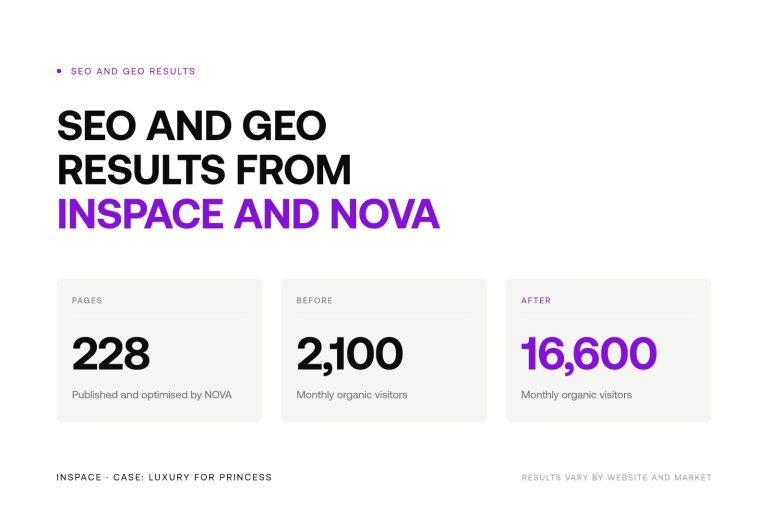
At InSpace, this is the logic behind AI-first execution. The focus is not just on generating content, but on structured visibility across core themes in Google, ChatGPT, Gemini, and other AI platforms. That includes long-tail and question-based articles, informational pages for AI answers, cluster-optimized category hubs, conversion-aligned service content, and scalable publishing workflows through NOVA.
The strategic takeaway is simple: AI works best when it strengthens a clear topical system. Without that system, it just increases content volume.
Best practices for AI content and topical authority in 2026
- Start with one core theme and expand from there
- Build clusters around real search intent, not keyword lists alone
- Create pillar pages that consolidate authority
- Use supporting pages to answer specific long-tail questions
- Write direct, extractable answers for AI-driven search environments
- Keep terminology and positioning consistent across the cluster
- Use internal links to reinforce hierarchy and relationships
- Refresh strategic pages when the topic changes or expands
- Measure performance at cluster level, not just page level
- Use AI to scale execution, but keep human editorial judgment in the process
FAQ
Can AI-generated content build topical authority?
Yes, but only if it is part of a well-structured topic strategy. AI-generated content on its own does not create authority. It needs clear topical focus, strong internal linking, search intent alignment, and useful depth across a cluster.
What is the difference between topical authority and domain authority?
Topical authority is about how strongly your site covers a specific subject. Domain authority is a broader third-party concept often used to estimate overall link strength. In AI search, strong topical signals can matter more than broad site-level strength for subject-specific visibility.
How long does it take to build topical authority?
That depends on competition, site history, content quality, and cluster completeness. In many cases, you can see early gains on long-tail terms within weeks or months, while stronger authority across a full topic usually takes sustained publishing and refinement.
Does topical authority help with visibility in ChatGPT and Gemini?
It can. AI platforms and AI-enhanced search systems tend to prefer clear, relevant, well-structured content from sources that show consistent expertise. Topical authority improves your chances of being understood and selected as a useful source.
How many articles should be in a content cluster?
There is no fixed rule, but 10 to 15 well-connected pages can be a solid starting point for a focused niche. More competitive or broader topics often need larger clusters with stronger supporting architecture.
Do pillar pages still matter for AI SEO?
Yes. Pillar pages help define the main authority page for a topic, connect supporting subtopics, and create a clearer knowledge structure for both users and search systems.
What kind of pages are best for AI content and topical authority?
The strongest mix usually includes pillar pages, long-tail guides, question-based articles, informational pages designed for answer extraction, and commercial pages that align with the same thematic cluster.
Is more content always better for topical authority?
No. More content only helps if it expands useful coverage and strengthens the cluster. Low-quality or unrelated pages can dilute your topical focus and make the site harder to understand.