
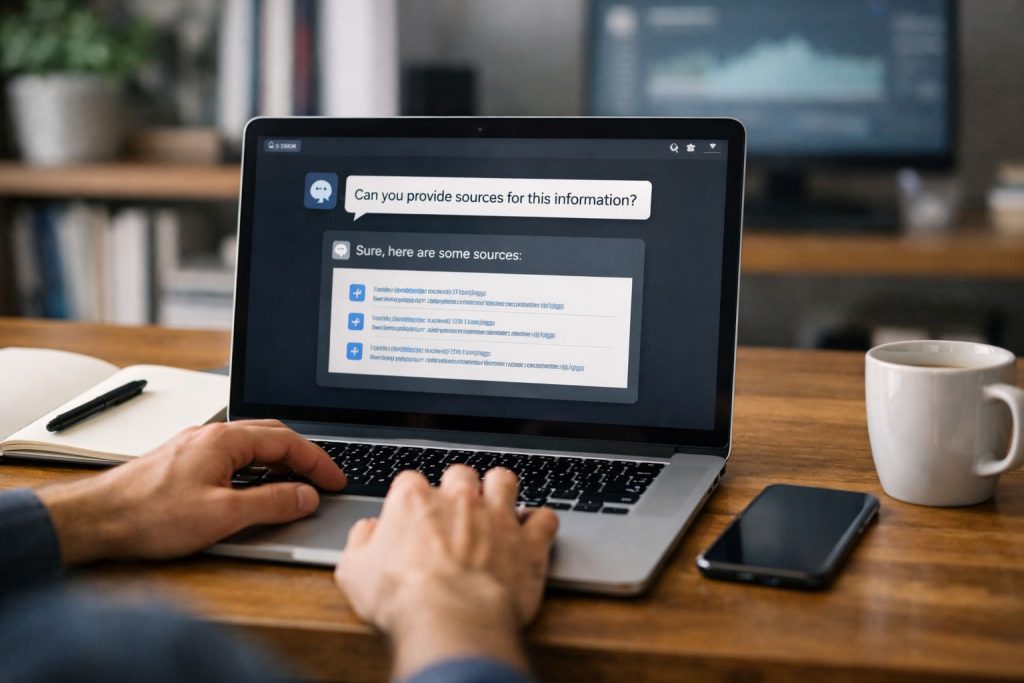
If you want AI to give you sources and citations you can actually use, the quality of your prompt matters as much as the quality of the answer. Vague requests often lead to incomplete references, missing publication details, or made-up citations. A better approach is to ask AI for verifiable sources, define the citation style, require direct links or identifiers, and then check every reference before using it. That is the fastest way to use AI for citations without relying on unreliable output.
Below, you will learn how to ask AI for sources and citations in a way that produces more accurate results, when AI can help, where it commonly fails, and how to verify what it gives you before you cite anything in academic, professional, or editorial work.
Why AI often gets sources and citations wrong
Many people ask a model something simple like “give me sources for this” and expect a ready-to-use bibliography. That is where problems start. AI can generate text that looks correct even when the source does not exist, the author name is wrong, the title is incomplete, or the year is fabricated.
This happens because AI predicts plausible language patterns. It does not automatically retrieve a real source database unless the specific tool and mode you use support live browsing, document retrieval, or connected search. Even then, you still need to verify the output. Understanding what an LLM is helps explain why plausible-looking references can still be inaccurate.
The most common citation problems include:
- Invented articles, books, or journal names
- Incorrect author names or publication years
- Broken or irrelevant URLs
- Real sources paired with the wrong claims
- Formatting that looks like APA, MLA, or Chicago but contains errors
So if you are wondering how to ask AI for sources and citations, the core principle is simple: ask for evidence in a format that can be checked, not just for polished-looking references.
How to ask AI for sources and citations the right way
A strong prompt tells the AI exactly what kind of sources you need, how recent they should be, what they need to support, and how you want them presented. The clearer your request, the more useful the response becomes. For broader prompting techniques that improve sourcing discipline, see How to use AI for content writing.
What to include in your prompt
- Your topic or claim: Be specific about what you need evidence for
- Source type: Ask for peer-reviewed studies, government sources, books, industry reports, or legal materials
- Date range: Useful when you need current evidence
- Citation style: APA, MLA, Chicago, IEEE, or another style
- Verification fields: Ask for DOI, ISBN, publisher, journal title, or a direct URL
- Confidence filter: Tell the AI not to guess and to say when it is uncertain
A reliable base prompt
You can start with a prompt like this:
Find 5 credible sources about [topic]. Only include sources you are confident are real. For each source, give the full title, author, publication year, publisher or journal, DOI or direct URL, and a 1 sentence summary of why it is relevant. If you are unsure about any source details, say so instead of guessing.
Why this works better than a generic request
This prompt reduces hallucinations because it asks for specific metadata and explicitly tells the model not to invent missing details. It also makes verification faster because you can immediately check the DOI, journal, publisher, or URL.
Best prompts for different citation needs
Not every search intent is the same. Sometimes you need raw sources. Sometimes you need formatted references. Sometimes you want support for a specific sentence. Asking in the right way improves output quality. This is closely related to understanding search intent for AI engines before you write the prompt.
When you need sources for a claim
Use this when you have a statement that needs evidence:
Give me 3 reliable sources that support this claim: “[insert claim].” Prioritize peer-reviewed or official sources. For each one, explain exactly which part of the claim it supports and provide a direct link or DOI.
When you need citations in a specific style
Use this when the source matters and formatting matters:
Find 5 real sources on [topic] and format them in APA 7. Include the raw source data below each citation so I can verify the formatting.
This is especially useful because AI may format citations incorrectly. Seeing the raw details helps you catch errors.
When you need academic sources only
Use this if you are working on research, essays, or literature review support:
Give me recent peer-reviewed academic sources on [topic] from the last 5 years. Exclude blogs and commercial pages. Include DOI, journal name, publication year, and a short note on relevance.
When you need help finding primary sources
Use this when secondary commentary is not enough:
Help me find primary sources on [topic]. Prioritize original research, official datasets, legislation, court rulings, or direct institutional publications. Explain why each source counts as primary.
When you want AI to check your citations
AI can also help as a reviewer:
Check these citations for APA 7 formatting errors. Do not rewrite blindly. For each citation, explain what may be wrong, what information seems missing, and what I should verify in the original source.
Prompt examples that usually produce better citations
If you want to know how to use AI to cite sources, these prompt patterns are far more effective than one-line requests.
Prompt for finding usable sources
Find 5 trustworthy sources about the impact of AI on search behavior. Use studies, major research firms, or official publications only. For each source, include title, author, year, source type, DOI or URL, and 2 key findings.
Prompt for building a reference list
Using only verified sources, create a Chicago style bibliography on [topic]. If any detail is missing or uncertain, flag it clearly rather than completing it from memory.
Prompt for source-backed writing help
Draft a short paragraph about [topic] and attach 1 supporting source after each major claim. Use only sources that can be directly verified with a DOI, ISBN, or official URL.
Prompt for citation transparency
If you cannot verify a source, do not include it. Separate your answer into two sections: verified sources and sources that require manual checking.
How to verify AI-generated sources before using them
This is the most important part. Even if the citations look polished, you should not trust them without checking. The top-ranking content on this topic strongly emphasizes verification, and that is the right standard.
A practical verification workflow
- Search the exact title in Google Scholar, Crossref, a library database, or the publisher website
- Check whether the author, title, year, and publication outlet match
- Confirm the DOI, URL, or ISBN
- Open the actual source and verify that it supports the claim you want to make
- Only then format it in your required citation style
For a step-by-step process that includes fact-checking, source control, and outbound citations, use the AI content optimization checklist.
Red flags that a citation may be fake
- The title sounds generic and cannot be found anywhere
- The journal name exists, but the article does not
- The DOI format looks strange or leads nowhere
- The source is repeatedly cited online with slightly different metadata
- The AI gives a confident answer but no direct traceable source path
What to do when AI gives uncertain references
If a tool says a source may be incomplete, treat that as a warning, not a minor issue. Ask it to help you refine the search instead of asking it to fill in the blanks. For example:
I cannot verify source number 3. Help me find the correct publication by searching for alternative titles, authors, or related works on the same topic.
Can you use AI for citations?
Yes, but with limits. AI is useful for discovering likely sources, generating search angles, converting source details into a citation style, and checking for formatting issues. It is not a substitute for source verification. If you are in school, publishing, or working in a regulated field, you should also check whether AI use is allowed under your instructor, editor, employer, or journal guidelines.
A safe rule is this: use AI to assist your research process, not to replace it. That means you can use it to find leads, organize references, and improve formatting, but you remain responsible for confirming that every citation is real and relevant. The same standard applies when creating high-trust AI articles that need trustworthy support. For implementation guidance, see How to create E-E-A-T-proof AI content.
How AI fits into APA, MLA, Chicago, and IEEE citation work
Different citation styles handle AI-related material differently, and formatting rules continue to evolve. The SERP analysis shows that style-specific guidance matters, especially for academic users. If you ask AI for help with citations, specify the style and request both the formatted citation and the raw metadata.
APA
Ask for author, date, title, source, and URL or DOI in APA 7 format. Then check punctuation, capitalization, and whether the source type was identified correctly.
MLA
Ask the AI to provide the Works Cited entry plus the source details used to build it. MLA errors often happen around titles, container names, and access information.
Chicago
Ask whether you need notes-bibliography or author-date format. Chicago can vary based on source type, so generic prompts often produce inconsistent results.
IEEE
Ask for numbered references in IEEE style and request the publication type explicitly, such as journal article, conference paper, or website. This helps reduce formatting mistakes.
What is the best AI that provides citations?
No AI tool should be treated as automatically reliable just because it provides citations. The better question is whether the tool can connect to real web results, academic databases, or your uploaded documents, and whether it shows enough source detail for verification. That becomes even more important in environments shaped by LLM answer engines (see How to optimize for LLM answer engines), where visibility and source clarity influence how information is surfaced.
In practice, the best setup is usually a combination:
If you rely on Perplexity for research, see How to optimize for Perplexity AI to increase the chance your sources are surfaced and cited.
- An AI assistant for summarizing and structuring
- Google Scholar, library databases, or publisher sites for source validation
- A citation manager for final formatting and storage
If a tool claims to provide citations, test it with a topic you already know well. Check whether the references exist, whether they support the claims made, and whether the formatting holds up under manual review.
A simple framework you can reuse every time
If you regularly need AI for citations, use this repeatable process:
- Define the exact claim or topic
- Ask for real, verifiable sources only
- Require DOI, URL, ISBN, or publisher data
- Specify the citation style
- Verify every source manually
- Use AI again only to help format or review
This gives you the speed of AI without accepting the risk of fabricated references.
Prompt templates you can copy
Find sources
Find 5 credible sources on [topic]. Only include sources you are confident are real. For each source, give author, title, year, publisher or journal, DOI or direct URL, and a short summary.
Support a specific statement
Give me sources that support this claim: “[insert claim].” For each source, explain which part of the claim it supports and include a direct verification link.
Format citations
Format these verified source details in MLA 9. If any required data is missing, tell me what is missing instead of guessing.
Audit a bibliography
Review this reference list for accuracy and formatting. Flag possible hallucinations, missing metadata, and style issues. Do not invent corrections.
FAQ
How do you ask AI for sources and citations?
Be specific. Ask for sources on a defined topic or claim, require verifiable details such as DOI or direct URL, name the citation style you need, and tell the AI not to guess if it is unsure.
How do you use AI to cite sources?
Use AI to help gather source details, organize references, and format citations. Then verify each source manually before you submit or publish anything.
Are you allowed to use AI for citations?
Often yes, but permission depends on your school, workplace, publisher, or journal. Always check the relevant policy, especially for academic or formal submissions.
What is the AI that provides citations?
Several AI tools can generate citations, but none should be trusted without verification. The most useful tools are the ones that provide direct links, metadata, or source retrieval support rather than just formatted text.
Can AI make up citations?
Yes. AI can hallucinate references that look real. That is why title checks, DOI checks, and source validation are essential. Stronger editorial trust signals, including ideas discussed in AI and E-E-A-T: how to show experience in AI content, can help reduce the risk of relying on unsupported claims.
Should you cite AI itself?
Sometimes. If AI materially contributed to your work and your institution or publisher requires disclosure, you may need to describe or cite that use according to the relevant style guide or policy. In some publishing workflows, clearer source labeling and structured data for GEO can also support transparency around content provenance.