
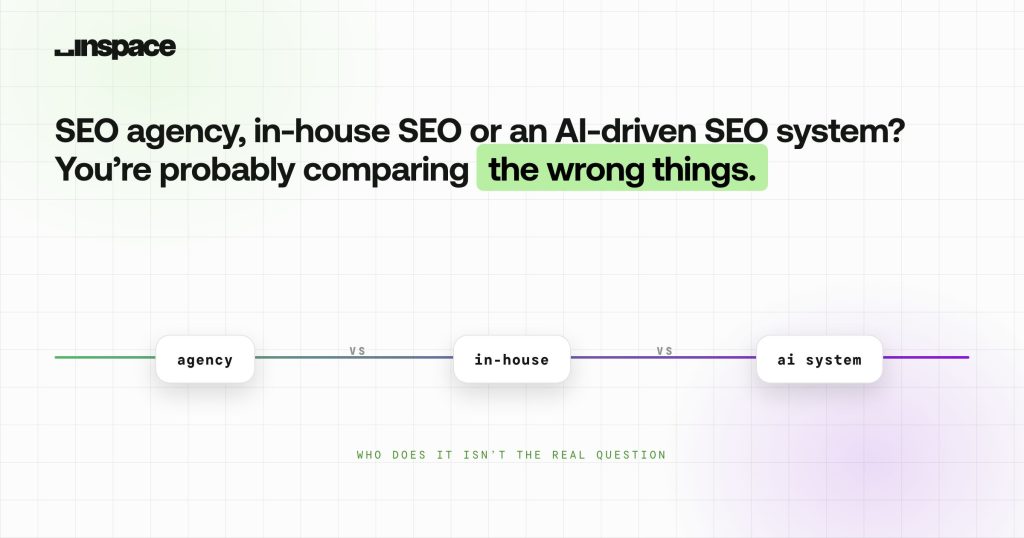
The short answer is that there isn’t a universally right way to approach SEO anymore.
An experienced SEO agency can absolutely be the right decision. So can building an internal team. The mistake isn’t choosing one over the other. The mistake is assuming they’re all designed to solve the same problem.
They aren’t.
Spend enough time talking to businesses investing in organic growth and you’ll notice something interesting. Hardly anyone is asking whether SEO still works. That debate ended years ago.
Today’s question is different.
“How do we actually keep up with everything SEO now requires?”
That’s a much harder question to answer.
Because modern SEO isn’t one job anymore. It’s technical optimisation, commercial landing pages, internal linking, entity optimisation, localisation, structured data, content improvement, AI visibility and continuous optimisation across hundreds or even thousands of pages.
Very few businesses struggle because they don’t know SEO matters.
They struggle because the amount of work required keeps growing.
That’s why comparing agencies, internal teams and AI systems as if they’re interchangeable products leads to the wrong conclusion before the conversation has even started.
An SEO agency gives you expertise. It doesn’t remove the workload.
A good SEO agency is one of the fastest ways to gain access to experience that would otherwise take years to build internally.
They’ve seen migrations go wrong. They know which technical issues actually affect rankings. They understand search intent across different industries and recognise opportunities that many businesses simply overlook.
That’s incredibly valuable.
But expertise and execution aren’t the same thing.
Every agency ultimately operates within the limits of human capacity. More optimisation requires more strategists. More pages require more writers. Expanding into more markets usually means expanding the team behind the work.
That’s not a criticism of agencies.
It’s simply how service businesses scale.
If your biggest challenge is defining the right strategy, an experienced agency is often exactly what you need.
If your biggest challenge is executing thousands of improvements consistently, strategy alone won’t solve it.
Hiring in-house changes ownership, not the amount of work.
Building an internal SEO team solves a different problem.
Your team understands the product, the customers and the commercial priorities better than anyone outside the business ever could.
That context is incredibly valuable.
But one SEO specialist doesn’t magically replace every SEO discipline.
The same person is expected to think strategically, perform technical audits, optimise existing pages, create new commercial content, improve internal linking, analyse performance, coordinate developers and increasingly optimise for AI answer engines.
Eventually most in-house SEO specialists stop spending their time improving the website.
They spend their time deciding which important work simply won’t get done this month.
That’s rarely a knowledge problem.
It’s an execution problem.
This is where most AI platforms miss the point.
The first generation of AI SEO software focused almost entirely on content generation.
Write blogs faster.
Publish more articles.
Scale content production.
The assumption was simple.
More content equals more rankings.
Except that’s rarely how organic growth works.
The businesses dominating competitive search results aren’t winning because they publish the most blog posts.
They’re winning because they’re continuously improving every part of their website.
Commercial pages.
Category pages.
Location pages.
Internal links.
Technical optimisation.
Content freshness.
Entity relationships.
Schema.
AI visibility.
Writing is only one small piece of a much larger operating system.
That’s why AI-driven SEO systems are fundamentally different.
This is also where many businesses misunderstand platforms like NOVA.
NOVA isn’t designed to replace an agency.
It isn’t designed to replace your internal marketing team either.
It removes the execution bottleneck that both models eventually run into.
Instead of treating SEO as hundreds of separate tasks, NOVA treats it as one connected system.
Research automatically informs planning.
Planning drives commercial page creation.
Internal linking evolves as the website grows.
Existing pages are continuously improved instead of being forgotten after publication.
Technical optimisation happens alongside content instead of becoming a quarterly project.
Publishing becomes continuous instead of campaign-based.
The result isn’t just more content.
The result is significantly more work being completed without needing significantly more people.
That’s a fundamentally different operating model.
So which approach is right?
That depends entirely on where your bottleneck is.
If you need strategic guidance, work with people who have solved these problems before.
If SEO needs to become a core capability inside your organisation, building internal expertise makes complete sense.
But if you already know what needs to happen and your biggest challenge is actually getting it done across hundreds or thousands of pages, you’re no longer solving a knowledge problem.
You’re solving an execution problem.
That’s exactly what fully AI-driven SEO and GEO systems like NOVA are built for.
The future of SEO won’t belong to the companies with the biggest agency retainers.
It won’t belong to the companies hiring the largest internal SEO teams either.
It will belong to the companies that combine human strategy with AI systems capable of executing that strategy every single day, at a scale that simply isn’t practical through manual workflows alone.