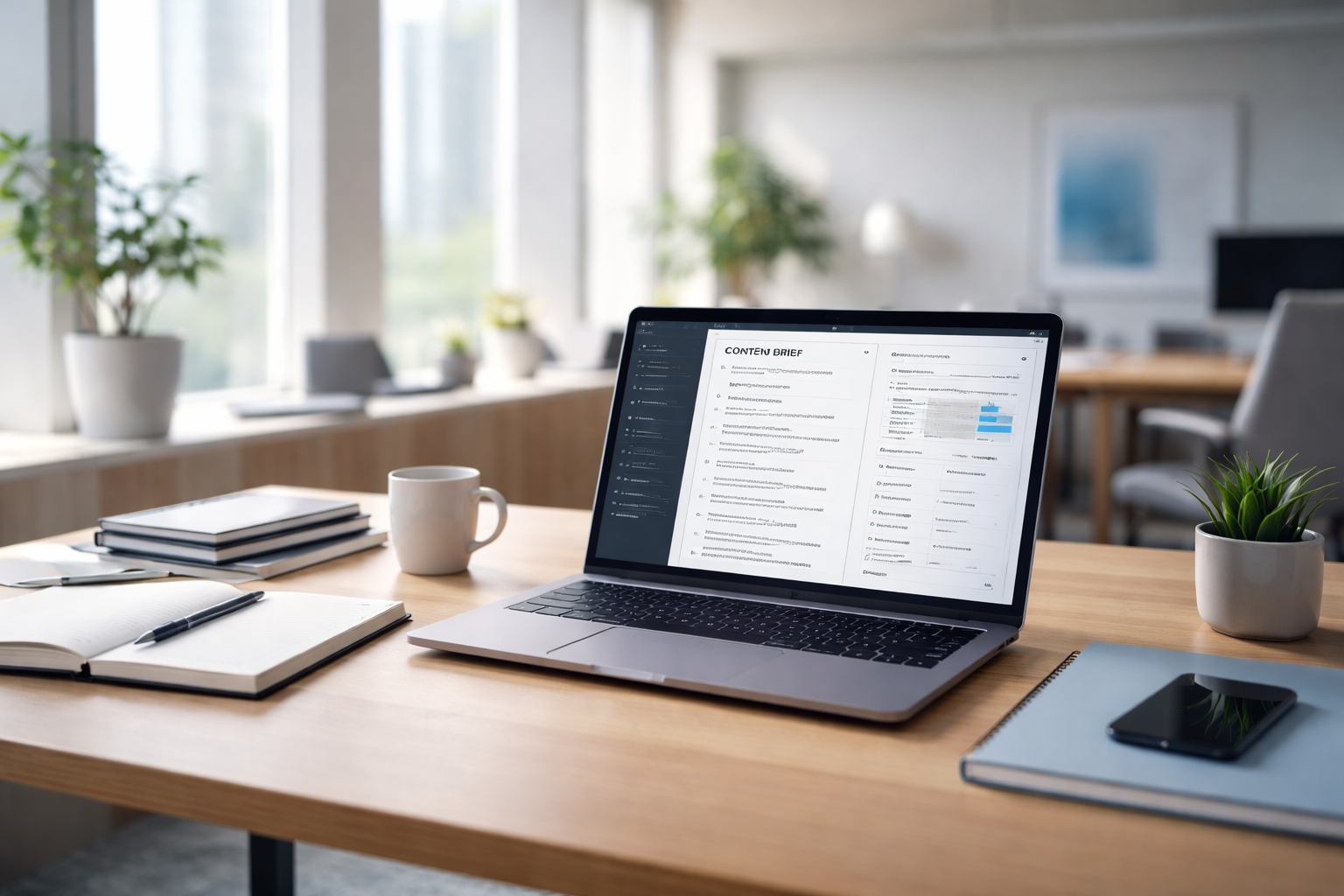
High quality content starts with a sharp brief. AI for content briefs helps you turn keyword research and search intent analysis, SERP insights, and brand guidelines into a concise, writer-ready outline in minutes. Instead of stitching data from spreadsheets and tabs, you can generate structure, angle, talking points, and FAQs that match search intent and your brand voice. In this guide, you will learn what to include in an AI-powered SEO content brief, a proven step-by-step workflow, a copyable prompt, selection criteria for tools, and practical tips to avoid common pitfalls.
Why AI belongs in your briefing workflow
Most teams struggle to scale briefs without losing quality. AI content brief generators speed up research, create consistent structures, and surface gaps you might miss. They analyze SERPs, cluster keywords, and suggest outlines aligned to intent, so writers can focus on expertise and examples. Used well, AI reduces prep time, improves on-page completeness, and drives more predictable rankings and conversions. The key is pairing AI speed with human judgment for accuracy, differentiation, and brand fit. For a broader view of how AI supports content planning and production, see AI for SEO content creation.
| Task | Manual brief | AI-assisted brief |
|---|---|---|
| SERP analysis | 30-60 minutes of checks | Summarized in seconds with patterns |
| Keyword clustering | Spreadsheet work | Automatic clusters and synonyms |
| Outline creation | From scratch | Intent-aligned sections and FAQs |
| Brand voice | Writer-dependent | Guided by examples and rules |
| Consistency | Varies by editor | Standardized across briefs |
| Time to first draft | Slow and variable | Fast and repeatable |
What to include in an AI content brief
- Goal and KPI – organic traffic, signups, assisted revenue, or links.
- Primary keyword and cluster – target term, support keywords, variants.
- Search intent – informational, commercial, transactional, navigational.
- Audience and use case – role, pains, decision stage, objections.
- Angle and promise – unique POV, outcome, or differentiator.
- Structure – H2/H3 outline with word targets per section.
- Key talking points – must-include facts, data, examples.
- FAQs – People Also Ask and intent-matched questions.
- Competitor notes – gaps to fill, clichés to avoid.
- Brand voice – tone rules, do/don’t list, writing samples.
- Internal linking – target pages, anchor guidelines.
- External credibility – sources, stats, quotes to validate claims.
- Schema – Article, FAQPage, Product, or HowTo recommendations.
- Compliance – claims, regulated terms, or legal review steps.
Step-by-step workflow to generate a high quality brief
- Collect inputs – primary keyword, audience, goal, and brand voice samples.
- Scan the SERP – identify top formats, angles, and gaps for the query.
- Cluster keywords – group synonyms and supporting subtopics by intent.
- Draft with AI – feed inputs into your AI content brief generator.
- Refine structure – adjust H2/H3s, reorder for narrative flow, add word targets.
- Add proof – insert required stats, product examples, and internal links.
- Brand polish – apply tone rules, terminology, and style constraints.
- Expert review – have a subject-matter expert verify accuracy and nuance.
- Publish to CMS – export with schema and internal links, then assign to a writer.
- Measure and iterate – track rankings, CTR, and engagement to update briefs over time.
Example prompt and sample AI brief
Copy this prompt into your AI content brief generator and customize the fields in brackets.
Prompt: Create an SEO content brief for [primary keyword], targeting [country/region], for [audience role and stage]. Search intent is [informational/commercial/transactional]. Tone is [brand voice descriptor] following these rules: [2-3 do’s and don’ts]. Include: goal and KPIs, keyword cluster with priorities, outline with H2/H3 and word counts, key arguments with data needs, 6 FAQs, internal links to [URLs], external credible sources to cite, recommended schema, and differentiation notes vs [top competitors]. Avoid generic fluff and listicles without depth. End with an AI content optimization checklist for the writer.
Sample output snippet for a SaaS topic (primary keyword: project management software for startups, US, founders, commercial intent):
- Goal – Capture high-intent traffic and drive free trial signups. KPI: signups, assisted conversions, page-level ROI.
- Keyword cluster – project management software for startups, startup project tools, lean project management software, agile tools for startups, PM tools pricing for startups.
- Angle – Ship faster with fewer people: prioritize roadmaps, automate standups, and keep investor updates in one place.
- Outline
- H2: What startups need from project management tools – 180 words
- H2: Key features that prevent scope creep – 220 words
- H3: Lightweight roadmapping
- H3: Async updates and automation
- H3: Investor reporting templates
- H2: Pricing models for lean teams – 180 words
- H2: How to migrate without downtime – 200 words
- H2: FAQs – 250 words
- Key talking points – Time-to-value in days, integrations with Slack and GitHub, SOC 2, real customer example reducing cycle time by 27%.
- Internal links – /pricing, /integrations/slack, /case-studies/startup-x.
- External sources – Link to credible studies on startup failure modes and productivity benchmarks.
- Schema – Article + FAQPage for the FAQ block.
- Differentiation – Competitors over-index on feature lists; we lead with outcome-driven examples and migration steps.
- Writer checklist – Include one metric per H2, one customer quote, and a visual of the migration flow.
How to choose the right AI content brief tool
Match the tool to your volume, workflow, and compliance needs. Look for:
- SERP analysis depth – pulls headings, questions, and content gaps from current winners.
- Clustering and intent – automatic grouping with clear primary and secondary keywords.
- Brand controls – voice rules, terminology enforcement, and examples.
- Data provenance – citations or source suggestions for facts.
- Workflow integrations – CMS export, Docs, Sheets, task managers.
- Governance – roles, approvals, and version control.
- Value – pricing that fits team size and brief volume.
InSpace’s AI platform, Nova, combines strategy, clustering, AI content creation, schema, and publishing, so your briefs and content ship in one streamlined flow across major CMSs.
Best practices for consistent, on-brand results
- Seed with high quality inputs – share tone samples, past winners, and non-negotiable claims.
- Anchor to intent – decide early if the page is informational or commercial and structure accordingly.
- Quantify – specify target word counts, examples, and number of visuals per section.
- Differentiate – mandate a POV, proprietary data, or a concrete process step others miss.
- Document linking – provide exact anchors and URLs for internal links.
Pitfalls to avoid and how to fix them
- Generic outlines – Fix by inserting competitor gaps and mandatory talking points into the prompt.
- Hallucinated facts – Fix by requiring citations and pre-approving source domains.
- Voice drift – Fix by adding do/don’t examples and banned phrases.
- Overstuffed keywords – Fix by prioritizing 1 primary + 3-5 secondary terms and using natural variants.
- One-size-fits-all briefs – Fix by tailoring to audience stage and desired action.
Who benefits most from AI for content briefs
- Marketing teams – standardize briefs across product lines and regions to scale production.
- Agencies – accelerate research, keep brand voices distinct, and improve margin per brief.
- SaaS and e-commerce – align briefs with bottom-funnel intent and internal linking to PDPs or pricing.
- Freelancers – win clients with faster turnarounds and clearer scope.
Workflow integration and measuring impact
Integrate your brief generator with your research stack, docs, and CMS to cut handoffs. Export outlines with metadata and schema, auto-attach target links, and prefill task templates. Track success with a dashboard for brief-to-publish time, organic sessions, rankings for primary and cluster keywords, CTR, scroll depth, conversions, and assisted revenue. InSpace’s Nova automates clustering, technical optimization, and publishing, then monitors performance so you can iterate briefs based on real outcomes.
FAQ
What is an AI content brief generator?
An AI content brief generator is a tool that turns inputs like keywords, audience, and brand voice into a structured brief with headings, talking points, FAQs, and linking guidance. It uses SERP analysis and language models to align the outline with search intent and your goals.
How do you create content briefs with AI?
Provide the primary keyword, clustered variants, audience, goal, and tone rules. Ask the tool to propose H2/H3s with word targets, key arguments, FAQs, and links to include. Then refine sections, add citations, and finalize with brand and compliance checks before assigning to a writer.
Which AI tool is best for content creators?
The best choice depends on needs: deep SERP analysis and clustering for SEO teams, strong brand controls for larger organizations, and CMS integrations for fast publishing. If you want strategy-to-publish in one flow, InSpace’s Nova unifies clustering, briefs, content generation, schema, and distribution.
Is AI for content briefs free?
Many tools offer free tiers or trials, but advanced features like clustering, governance, and CMS export are usually paid. Evaluate value based on time saved, consistency gains, and the impact on rankings and conversions.
Accelerate your briefing with InSpace
Ready to turn research into writer-ready briefs in minutes? InSpace’s Nova pairs AI with SEO expertise to generate on-brand content briefs, publish at scale, and optimize performance across your CMS. Talk to our team in Eindhoven or Antwerp to see how Nova fits your workflow.