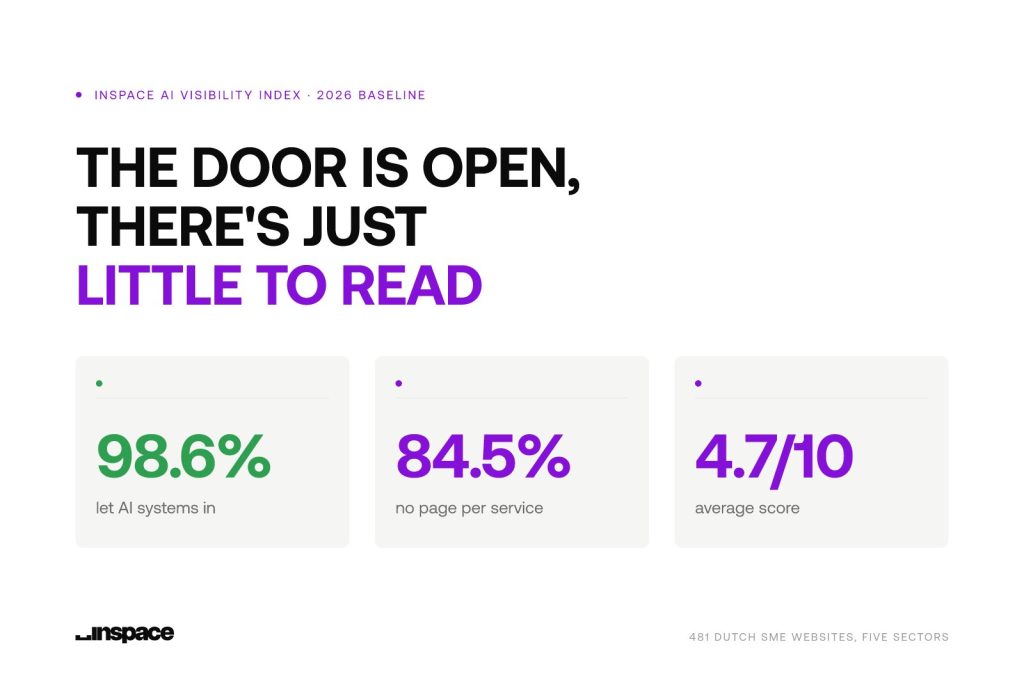
Eindhoven, 4 November 2026. Dutch SMEs are not keeping AI systems such as ChatGPT, Gemini and Perplexity out: 98.6 percent let them in. But on more than eight in ten websites, there is too little about the company’s own services to make clear what the business is good at and which problems it solves.
These are the findings of the first measurement of the InSpace AI Visibility Index, a study of 481 websites of Dutch small and medium-sized businesses across five sectors. Of the 433 sites that could be reached, 58.7 percent offer too little machine-readable context about the company and its services.
Across Europe, InSpace sees a fundamental shift in how people find and choose businesses: from search engines to conversations with AI assistants, and ultimately to agents that search, compare and prepare a choice on their behalf. Those assistants know no borders: an installer in Eindhoven is read by the same systems as a competitor in Antwerp or Düsseldorf. At that point it is no longer only about technical accessibility. It is about whether a business makes clear what it is good at, which problems it solves and whether it answers the questions that matter in its market.
The most common concern, that businesses accidentally block themselves from ChatGPT or Gemini, turns out to be hardly an issue: only 1.4 percent shut out AI crawlers. The door is open; there is just little to read.
On 84.5 percent of the sites, there is no separate page or description for each service. Almost half (48.5 percent) also lack machine-readable basic information about the company itself.
According to InSpace, that is where the biggest opportunity lies. Many SMEs have years of expertise, but barely explain it online. Those who do give AI assistants, and soon agents, something to work with when a customer asks a question about exactly that field.
On a scale from 0 to 5, an SME website scores 2.35 on average. IT services score highest (2.76), legal services lowest (2.13).
The domain name makes a difference too: of the sites without a .nl extension, such as .com or .eu, 39.1 percent offer too little context, compared with 62.1 percent of the .nl sites.
Follow-up measurements will show whether SME websites start explaining their expertise better. A methodology statement is available on request.
“Business owners don’t suddenly need to become AI experts. But they do need to make clear what their company is good at, which problems they solve and for whom. If your website barely answers that, the foundation is missing. Everyone is talking about becoming visible in AI. What we see is that many businesses have barely explained their own expertise online yet.”
Jelle Engels, Chief Visionary Officer at InSpace
About InSpace
InSpace is a technology company at the High Tech Campus Eindhoven. With NOVA, it helps businesses get found in Google and on AI platforms. InSpace serves more than 500 customers.
Press contact: Jelle Engels, Chief Visionary Officer, go@inspace.io, +31 85 020 2759
 We're always on comms.