

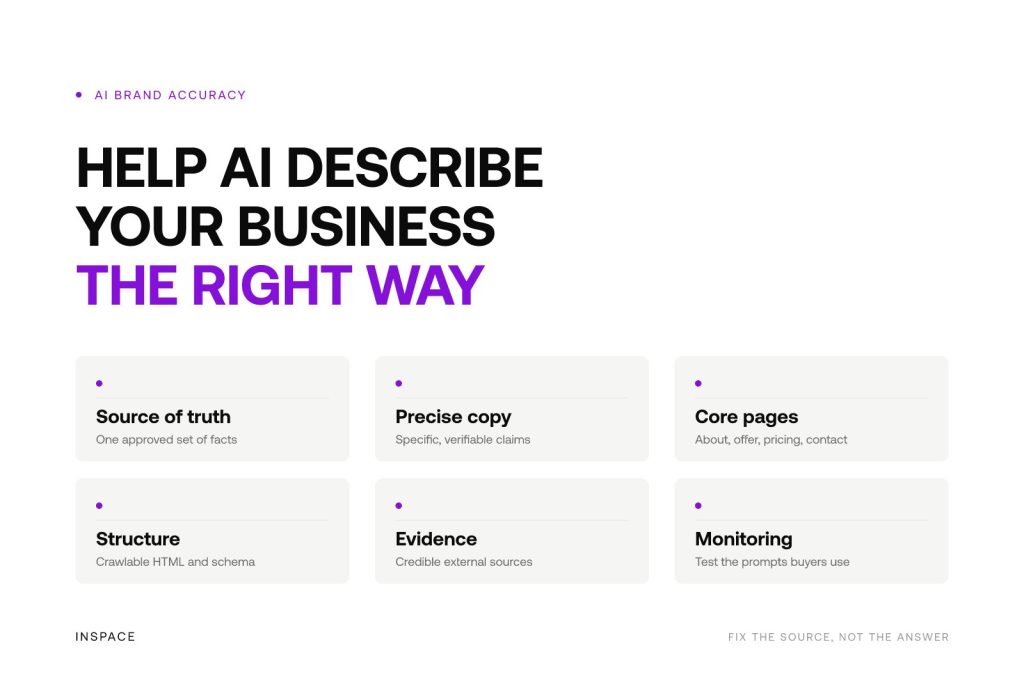
AI search tools and chatbots increasingly shape how potential customers discover brands, compare providers, and make purchase decisions. But AI does not always describe a company accurately. It can rely on outdated pages, incomplete third-party sources, inconsistent claims, or information from a competitor with a similar name.
You cannot control every answer generated by ChatGPT, Google AI Overviews, Perplexity, or other AI systems. You can, however, make your company information clearer, more consistent, easier to verify, and easier to cite. That gives AI systems stronger source material when they retrieve information about your brand.
The goal is not to write content for a chatbot. It is to build a trustworthy, well-structured digital presence that helps both people and AI understand exactly who you are, what you offer, and why your business is relevant.
Why AI can get company information wrong
Generative AI does not have a perfect, permanent database of every business. Its answers may be based on information in its training data, live web search results, indexed web pages, business listings, press coverage, and other accessible sources. When those sources conflict or lack detail, AI may fill gaps with assumptions.
Common reasons for inaccurate AI descriptions include:
- Old pricing, product features, services, or company details still published online.
- Different descriptions of your offer across your website, social profiles, directories, and partner sites.
- Important information hidden in PDFs, images, JavaScript-heavy pages, or inaccessible CMS sections.
- Thin service pages that mention a topic without clearly explaining the offer.
- Ambiguous brand names, especially when other companies operate under a similar name.
- Third-party sites that rank or get cited more often than your own official pages.
AI systems can also produce plausible but incorrect statements. That is why the most effective approach combines strong source content with regular checks of how your brand appears in AI-generated results.
Create a single source of truth for your business information
Start by defining the facts that must always be correct when your business is mentioned. This gives your website, marketing team, sales team, and external partners a shared reference point.
Your source of truth should cover the information customers most often need before they contact or compare you:
- Your official company and brand name.
- What you do, who you serve, and in which markets.
- Your core products or services and their main capabilities.
- Your differentiators, explained without vague marketing language.
- Current pricing or pricing approach, where relevant.
- Office locations, contact details, leadership information, and legal company details.
- Policies, certifications, partnerships, or compliance claims that can be substantiated.
Keep this information current and assign ownership. Someone should be responsible for reviewing changes to offers, pricing, messaging, and business details before old information spreads across your website and external channels. See our guides to source-of-truth pages for AI and creating datasets and factsheets for LLMs.
Use precise language, not broad claims
AI is more likely to misinterpret vague statements. A sentence such as “we offer innovative growth solutions” does not clearly explain what a company sells. A specific statement does.
For example, InSpace describes NOVA as AI software for SEO and GEO that researches search queries, creates or optimises pages, publishes through a CMS, and monitors AI visibility. That is clearer than calling it an “AI marketing platform.” Specific descriptions reduce ambiguity for users, search engines, and AI systems.
Be equally precise about limitations. Do not imply that a tool guarantees rankings, citations, recommendations, or mentions in AI answers when it does not. Clear, verifiable claims make your brand information more reliable over time.
Make core website pages easy for AI to understand
Your website should be the most authoritative source for information about your business. AI systems often use publicly available web content when searching for answers, so your key pages need to state important facts directly and consistently.
Prioritise these pages:
- About page: Explain who you are, what your company does, where you operate, and the expertise behind the business.
- Product or service pages: Describe what each offer includes, who it is for, how it works, and any relevant requirements or limitations.
- Pricing page: Keep pricing, packages, or your pricing model accurate if this information is public.
- Contact and location pages: Use consistent company details, addresses, phone numbers, and regional information.
- Help centre or knowledge base: Answer recurring customer questions with current, factual explanations.
Each page should have one clear purpose. Avoid forcing visitors or AI systems to infer what you mean from generic copy, disconnected feature lists, or unclear navigation.
Keep facts consistent across every important page
Inconsistency creates uncertainty. If your homepage says you serve European businesses, your service page says you operate globally, and a directory lists only the Netherlands, AI may combine those statements into an inaccurate answer.
Use the same approved wording for your company description, core services, markets, and product names across your website. You do not need identical copy everywhere, but the underlying facts must match.
Also review older blog posts, campaign landing pages, downloadable documents, and archived product pages. Outdated content can remain searchable long after an offer has changed.
Structure information for search engines and answer engines
Clear copy is essential, but technical accessibility matters too. Search engines and AI-powered answer engines need to crawl, interpret, and connect the information on your pages.
Support this with a solid technical SEO foundation:
- Use descriptive page titles, headings, URLs, and internal links.
- Make important content available as crawlable HTML, rather than placing key facts only in images or downloadable files.
- Use logical page structure, with one main topic per page.
- Apply relevant structured data where it accurately represents your business, such as Organization, LocalBusiness, Product, Service, or FAQ schema.
- Use canonical tags and redirects to prevent duplicate or obsolete pages from competing with current information.
- Keep pages fast, indexable, and accessible to search engine crawlers.
Structured data does not force an AI tool to use your information. It does, however, make key entities and relationships more explicit. For example, it can help clarify that a product belongs to your company, a location is an official office, or a service applies to a particular market. You can also use entity SEO to help search engines and AI interpret your business correctly.
Build evidence beyond your own website
AI systems often compare multiple sources before generating an answer. Your own website should lead the narrative, but credible independent references can help validate your business information.
Focus on sources that are genuinely useful for customers and relevant to your industry, such as:
- Accurate business profiles and professional directories.
- Partner and technology-provider pages.
- Expert interviews, conference profiles, and reputable industry publications.
- Well-documented case studies and client stories, where permission has been given.
- Company profiles on professional platforms that match your official website.
Do not try to create large volumes of low-quality mentions. A small number of credible, consistent sources is more valuable than a scattered footprint full of contradictory claims. Where appropriate, see how to implement source citation markup to better support verifiable claims.
Publish content that answers real customer questions
AI search experiences are designed to answer questions. If your website only contains sales-led copy, other sources may become the preferred explanation for your category, product, or expertise.
Create helpful content around questions prospects ask before buying. Explain terminology, selection criteria, processes, practical limitations, and common mistakes. Link that content to the relevant service or product pages so readers and search systems can understand the connection between your expertise and your offer.
For SEO and GEO providers, for example, relevant content might explain how AI visibility works, what influences citations in AI answers, or why accurate product pages matter for brand representation. The best educational content is specific, supported by experience, and updated when the market changes. This aligns with the role of entities and trust in GEO in generative search visibility.
Monitor how AI describes your business
AI visibility is not a one-time optimisation task. The information AI tools retrieve, cite, and summarise can change as search indexes, source pages, models, and competitor content change.
Regularly test prompts that reflect how prospective customers search, such as:
- What does [company name] do?
- Who is [company name] for?
- What are the main features of [product name]?
- What are the best providers for [service category] in [market]?
- How does [company name] compare with alternatives?
Record whether your brand is mentioned, whether the description is accurate, which pages are cited, and where misinformation appears. If an answer is incomplete, identify the information gap. If it is outdated, update the original source and reinforce the corrected information on your key pages.
InSpace helps brands monitor AI visibility, including brand mentions, page citations, and visibility trends. NOVA can use these insights to identify content improvements across pages, structure, and internal linking. Monitoring does not guarantee that an AI system will mention, cite, or recommend a brand, but it gives you a practical basis for improving the sources AI can use.
Use a repeatable quality-control process
Reliable AI representation depends on ongoing content governance. Build a simple review process rather than waiting until a customer points out an error in an AI answer.
- Audit existing information: Identify inaccurate, duplicated, unclear, and outdated claims across your website and major external profiles.
- Prioritise high-impact pages: Update your homepage, about page, core product or service pages, pricing information, and key comparison or FAQ content first.
- Standardise brand facts: Give marketing, sales, support, and partners approved descriptions and current proof points.
- Improve technical clarity: Resolve crawlability, duplicate content, internal linking, and structured data issues that make information harder to interpret.
- Track AI visibility: Monitor relevant prompts, citations, and changes in how your company is described.
- Review regularly: Revisit key facts whenever your offer, positioning, product, pricing, or market focus changes.
For growing businesses, this process turns AI visibility into a manageable part of SEO rather than a separate, unpredictable channel. Let’s build your organic advantage with content that is useful to customers, understandable to search systems, and accurate enough for AI to reference with confidence.
Frequently asked questions
How does AI get information about a company?
AI can use information from its training data, search indexes, live web results, public websites, directories, news articles, social profiles, and other accessible sources. The exact sources depend on the AI tool and whether it searches the web in real time. This is why your official website and key external profiles should provide consistent, current information.
Can you correct false information about your business in AI answers?
You cannot usually edit a generated answer directly. The most effective response is to correct the underlying sources: update inaccurate pages on your website, improve missing explanations, remove obsolete content where possible, and correct major third-party listings. Some AI platforms also offer feedback mechanisms, but source quality remains the most durable solution.
What information should be included on a company website for AI search?
Include a clear company description, your products or services, target customers, locations or markets, current contact details, pricing approach where relevant, and evidence supporting important claims. Make this information easy to find on dedicated pages and keep it consistent across the site.
Does structured data guarantee that AI will cite my website?
No. Structured data can help search engines understand the meaning and relationships within your content, but it does not guarantee inclusion in AI-generated answers or citations. Accurate content, technical accessibility, topical relevance, and source credibility all influence visibility.
 We're always on comms.